

Hibiscus tea has been studied for its potential effect on blood pressure, but drinking one cup should not be expected to cause an immediate or predictable drop.
Most research examining hibiscus and blood pressure looks at regular consumption over a period of time rather than what happens within minutes or hours after a single serving. This makes it difficult to say that hibiscus tea “works immediately” or to give an exact timeframe that applies to everyone.
In this guide, we’ll look specifically at how quickly hibiscus tea may affect blood pressure, what clinical research can—and cannot—tell us about timing, and why individual responses may vary.
How Long Does Hibiscus Tea Take to Lower Blood Pressure?
There is no established timeframe showing exactly how long hibiscus tea takes to lower blood pressure for an individual person.
Clinical studies that have reported blood pressure changes generally evaluated regular hibiscus consumption over time rather than measuring a guaranteed effect within minutes or hours of drinking a cup. The duration of these studies and the hibiscus preparations used have also varied.
This means that research findings cannot be converted into a precise timeline such as “after three days” or “after two weeks” for everyone.
Individual responses may depend on several factors, including baseline blood pressure, overall diet and lifestyle, medications, health conditions, and the hibiscus preparation being consumed.
If you have high blood pressure, your actual blood pressure readings are more useful than trying to predict when hibiscus tea should start working.
Why Doesn’t Hibiscus Tea Work Immediately?
Blood pressure can fluctuate throughout the day for many reasons, so a change measured shortly after drinking hibiscus tea would not necessarily prove that the tea caused it.
Research on hibiscus generally looks at patterns in blood pressure over time rather than treating a single cup as an immediate blood-pressure-lowering intervention. This is why hibiscus tea should not be expected to act like a fast-acting treatment for hypertension.
Researchers have investigated several compounds in Hibiscus sabdariffa that may help explain its potential effects on cardiovascular health, but the exact mechanisms and their importance in everyday brewed tea are still being studied.
The most useful way to interpret the evidence is therefore to focus on changes observed with regular consumption in clinical research rather than expecting a noticeable effect immediately after drinking a cup.
Does the Amount You Drink Affect How Quickly It Works?
Research does not establish that drinking more hibiscus tea will make its potential blood pressure effects occur faster. A stronger brew or a larger number of cups should not be assumed to produce a quicker or greater response.
Clinical studies have used different hibiscus preparations and amounts, making it difficult to identify one dose that produces an effect within a specific timeframe.
If your main question is how much hibiscus tea has been studied for blood pressure, see our dedicated guide on how much hibiscus tea to lower blood pressure.
People taking blood pressure medication should discuss regular hibiscus consumption with a healthcare professional rather than increasing their intake in an attempt to obtain faster results.
Does Consistency Matter?
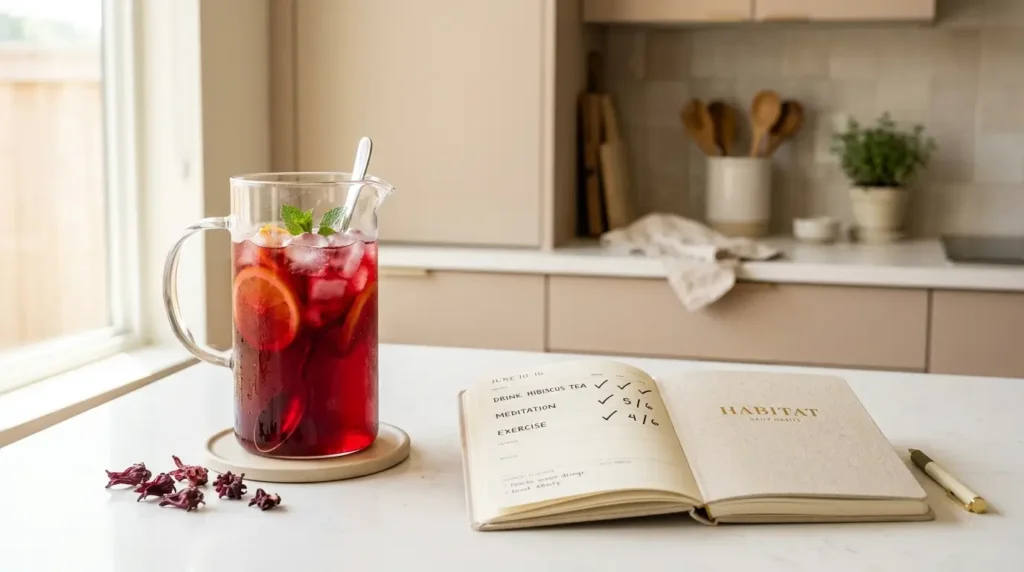
Studies examining hibiscus tea and blood pressure generally evaluate regular consumption over a period of time rather than occasional use. However, this does not mean that researchers have established a specific daily schedule that everyone needs to follow.
Drinking extra hibiscus tea on one day should not be assumed to compensate for missed days or to produce a faster blood pressure effect. Likewise, there is not enough evidence to say that maintaining specific “plasma levels” of compounds from brewed hibiscus tea is necessary for it to have an effect.
If you choose to drink hibiscus tea regularly, a simple routine may make it easier to be consistent, but there is no proven morning-and-afternoon schedule that works better for everyone.
For more information about timing, see our guide to the best time to drink hibiscus tea.
What Blood Pressure Reduction Can You Realistically Expect?
Research suggests that hibiscus may have a modest blood-pressure-lowering effect in some adults, but there is no specific reduction that everyone should expect.
Clinical studies have reported different results depending on factors such as participants’ starting blood pressure, the hibiscus preparation used, the amount consumed, and the length of the study. Average changes observed in a clinical trial should therefore not be interpreted as a prediction of what will happen to an individual person’s blood pressure.
This is especially important for people with hypertension. Hibiscus tea should not be relied on to bring blood pressure into a normal range or used as a reason to delay, reduce, or stop prescribed treatment.
The potential cardiovascular effects of hibiscus are discussed in more detail in our guide to hibiscus tea benefits.
Important Safety Considerations
Hibiscus tea is commonly consumed as a beverage, but people who take medication for high blood pressure should be cautious about using it regularly with the specific goal of lowering blood pressure.
Because hibiscus has been studied for potential blood-pressure-lowering effects, combining regular hibiscus consumption with antihypertensive medication may not be appropriate for everyone. A healthcare professional can provide guidance based on your medications, blood pressure readings, and overall health.
If you experience symptoms such as dizziness, lightheadedness, or fainting, do not assume that hibiscus tea is necessarily the cause. Blood pressure can change for many reasons, and symptoms that are persistent or concerning should be medically evaluated.
People with kidney conditions, as well as those who are pregnant or breastfeeding, should also seek individualized guidance before using hibiscus tea specifically for health purposes.
For more information, see our guide to hibiscus tea side effects and our article on hibiscus tea and kidneys.
Hibiscus tea should not be used to replace prescribed blood pressure medication or professional medical care.
Frequently Asked Questions
Does hibiscus tea lower blood pressure immediately?
Hibiscus tea should not be expected to produce an immediate or predictable drop in blood pressure after a single cup. Research generally evaluates regular consumption over time rather than an effect occurring within minutes or hours.
How long does hibiscus tea take to lower blood pressure?
There is no established timeframe that applies to everyone. Clinical studies have evaluated blood pressure changes over different periods, and individual responses can vary depending on factors such as baseline blood pressure, medications, health conditions, and the hibiscus preparation used.
Does drinking more hibiscus tea make it work faster?
There is no good evidence that drinking more hibiscus tea produces a faster blood pressure effect. Increasing the amount or making the tea stronger should not be assumed to accelerate results.
For information about amounts studied, see how much hibiscus tea to lower blood pressure.
Does hibiscus tea lower blood pressure as well as medication?
Hibiscus tea has been studied for potential blood-pressure-lowering effects, but it should not be considered equivalent to prescribed antihypertensive medication. Study results vary, and hibiscus tea should not be used to replace, reduce, or stop prescribed treatment.
Can hibiscus tea lower blood pressure too much?
People who already have low blood pressure or take blood pressure medication should be cautious with regular hibiscus consumption. If you experience dizziness, lightheadedness, fainting, or other concerning symptoms, seek appropriate medical advice rather than assuming hibiscus is the cause.
What is the best time to drink hibiscus tea for blood pressure?
Research does not establish a specific time of day that makes hibiscus tea more effective for blood pressure. For a broader discussion of timing, see the best time to drink hibiscus tea
Is hot or cold hibiscus tea better for blood pressure?
There is not enough evidence to conclude that hot hibiscus tea lowers blood pressure faster or more effectively than cold hibiscus tea. Preparation methods vary across studies. See our detailed comparison of hibiscus tea hot or cold
Key Takeaways
- Hibiscus tea should not be expected to lower blood pressure immediately after a single cup.
- Research generally evaluates regular hibiscus consumption over time rather than effects occurring within minutes or hours.
- There is no established timeframe that predicts exactly when an individual person’s blood pressure will change.
- Drinking more hibiscus tea or making it stronger should not be assumed to produce faster results.
- Individual responses may vary depending on baseline blood pressure, medications, health conditions, lifestyle, and the hibiscus preparation used.
- People taking blood pressure medication should discuss regular hibiscus consumption with a healthcare professional.
- Hibiscus tea should not replace prescribed medication or professional treatment for hypertension.