

Nootropic drinks are becoming increasingly common in cafés, supplement aisles, and the functional beverage market. They are often marketed with words such as focus, clarity, brain fuel, or calm energy.
But what exactly makes a beverage “nootropic”?
In practice, nootropic drinks are beverages containing ingredients marketed to support aspects of cognitive performance, such as alertness, attention, memory, or mental focus. Depending on the product, those ingredients may include caffeine, L-theanine, botanical extracts, functional mushrooms, vitamins, or other compounds.
That doesn’t mean every nootropic beverage improves brain function, however. The evidence varies considerably by ingredient, preparation, amount, and population studied.
This guide explains common nootropic beverage ingredients, what research suggests about them, how nootropic drinks differ from energy and adaptogenic drinks, and what to consider before trying one.
What Is a Nootropic Drink?
The term nootropic is broadly used for substances marketed or studied for potential effects on cognitive function.
A nootropic drink puts one or more of these ingredients into beverage form.
Common formats include:
- Ready-to-drink beverages
- Sparkling functional waters
- Coffee blends
- Tea and matcha drinks
- Functional mushroom drinks
- Powdered drink mixes
- Small functional beverage shots
There is no single standardized formula for a nootropic drink.
One product might simply combine caffeine and L-theanine, while another may contain mushrooms, botanical extracts, vitamins, and several other ingredients.
Because formulations vary so much, the words nootropic drink alone tell you relatively little about what a product may actually do.
Common Nootropic Beverage Ingredients
When evaluating a nootropic beverage, the ingredient list matters more than the marketing language on the front of the package.
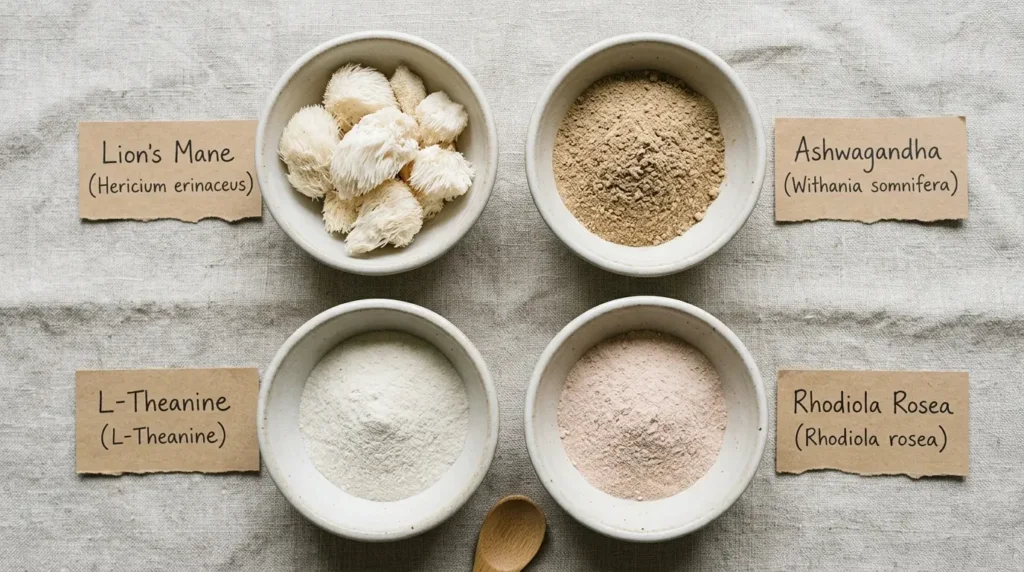
Here are some ingredients you may encounter.
| Ingredient | Why It’s Added | Important Consideration |
|---|---|---|
| Caffeine | Alertness and attention | Can affect sleep and cause jitteriness in some people |
| L-theanine | Often paired with caffeine | Research commonly examines it alone or with caffeine |
| Lion’s mane | Marketed for cognitive support | Human evidence remains limited |
| Ashwagandha | Often marketed for stress support | Not primarily a stimulant; has safety and interaction considerations |
| Rhodiola | Marketed for fatigue and stress | Evidence varies by preparation |
| Bacopa | Studied for memory and cognition | Research generally involves supplements rather than drinks |
| Citicoline | Studied in relation to cognitive function | Evidence depends on population and formulation |
| B vitamins | Normal nervous-system functions | More is not necessarily better if intake is already adequate |
Let’s look at these ingredients more closely.
Caffeine
Caffeine is one of the most familiar ingredients used in beverages for alertness.
It is naturally present in coffee and tea and may also be added to functional beverages.
Caffeine can temporarily increase alertness and reduce feelings of fatigue, which is one reason it appears in both energy drinks and some nootropic beverages.
However, individual responses vary.
Too much caffeine may cause:
- Jitteriness
- Restlessness
- Difficulty sleeping
- Increased heart rate
- Anxiety or nervousness in susceptible people
When comparing nootropic drinks, check the actual caffeine amount rather than assuming a product provides “clean” or “calm” energy simply because it is marketed as a nootropic.
L-Theanine
L-theanine is an amino acid naturally present in tea.
It has attracted particular interest because it is frequently studied alongside caffeine.
Some research suggests that combinations of caffeine and L-theanine may affect certain measures of attention and cognitive performance.
However, results from specific research preparations shouldn’t automatically be applied to every commercial beverage containing both ingredients.
The quantities can differ substantially from one product to another.
Tea naturally contains both caffeine and L-theanine, although their concentrations vary according to the type of tea and how it is prepared.
If you’re interested in that comparison, see our matcha vs coffee guide.

Lion’s Mane Mushroom
Lion’s mane (Hericium erinaceus) is a functional mushroom increasingly found in mushroom coffees and beverages marketed for focus or cognitive support.
Laboratory and animal research has generated considerable interest in compounds found in lion’s mane, and a limited number of human studies have also investigated cognitive outcomes.
However, human evidence remains relatively limited.
Research may also use particular extracts that aren’t equivalent to the small amount of mushroom powder found in a commercial beverage.
This is an important distinction when evaluating marketing claims.
You can read more about functional mushrooms in our mushroom coffee benefits guide.
Ashwagandha
Ashwagandha (Withania somnifera) is more commonly described as an adaptogenic botanical than a traditional nootropic.
Nevertheless, it appears in some beverages marketed for calm focus, stress support, or productivity.
Research has examined certain ashwagandha preparations for stress and sleep, but that does not establish that every beverage containing ashwagandha improves concentration or cognitive performance.
The preparation and amount matter.
Ashwagandha also deserves more caution than ordinary beverage ingredients because it can cause side effects and may interact with medications or be inappropriate for certain people.
For a broader explanation, see our adaptogenic drinks guide.
Rhodiola
Rhodiola (Rhodiola rosea) is another botanical commonly associated with the adaptogen category.
It has been investigated for fatigue, stress, and aspects of mental performance, but studies vary in quality, population, extract, and outcome.
Therefore, claims that a rhodiola-containing beverage will reliably improve productivity or mental endurance go beyond what can be concluded simply from seeing the ingredient on a label.
Bacopa Monnieri
Bacopa is a botanical with a long history of traditional use and has also been studied in relation to memory and cognition.
Some clinical research has reported effects on certain aspects of memory after continued use.
However, an important limitation applies to beverages: research typically involves specific supplemental preparations used over time.
A bottled beverage containing bacopa isn’t automatically equivalent to those preparations.
Citicoline
Citicoline is a compound involved in pathways related to phospholipids and neurotransmitter metabolism.
It has been studied in several neurological and cognitive contexts.
Some nootropic beverages include citicoline and market it for focus or memory.
As with other ingredients, the existence of research on citicoline doesn’t prove that every beverage containing it will noticeably improve cognitive performance in a healthy person.
The population studied, amount, duration, and formulation all matter.
B Vitamins
B vitamins such as B6, folate, and B12 play important roles in normal metabolism and nervous-system function.
Deficiencies can have health consequences, including neurological effects in some cases.
That doesn’t mean consuming additional B vitamins beyond your needs automatically improves focus or memory.
A beverage containing B vitamins should therefore not be assumed to provide a cognitive boost simply because those nutrients are important to normal brain function.
Nootropic Drinks vs. Energy Drinks
These categories can overlap.
An energy drink generally emphasizes stimulation, often through caffeine and sometimes sugar or other ingredients.
A nootropic beverage is usually marketed more specifically around:
- Focus
- Attention
- Memory
- Mental clarity
- Productivity
- Calm energy
But these are marketing categories rather than strict scientific classifications.
A highly caffeinated nootropic drink may function very similarly to an energy drink.
That’s why checking the ingredient list and caffeine content is more informative than relying on the category printed on the can.
Nootropic Drinks vs. Adaptogenic Drinks
There is also considerable overlap between nootropic and adaptogenic beverages.
Nootropic drinks are generally marketed around cognitive performance.
Adaptogenic drinks are usually marketed around stress, resilience, or general wellness.
Some ingredients, such as ashwagandha or rhodiola, may appear in both categories.
A single beverage could therefore be marketed as both nootropic and adaptogenic.
The distinction is less important than understanding what the beverage actually contains.
Do Nootropic Drinks Really Work?
There isn’t a simple yes-or-no answer.
“Nootropic drink” describes a large category of beverages rather than one standardized intervention.
Some ingredients have substantially more research than others.
Caffeine, for example, has extensive evidence for temporary effects on alertness and attention.
Other ingredients may have promising but more limited research, particularly when it comes to healthy adults.
Another major issue is that studies frequently investigate standardized supplements or specific ingredient combinations rather than commercially available drinks.
A research finding involving a particular extract cannot automatically be transferred to every beverage listing the same plant or mushroom.
So the better question is:
Does this particular beverage contain ingredients, amounts, and preparations that resemble those actually studied?
Sometimes the label doesn’t provide enough information to answer that question.
How to Read a Nootropic Drink Label
This is one of the most useful skills when comparing products.
Check the Caffeine Content
Don’t assume that a beverage marketed as “calm focus” or “clean energy” contains little caffeine.
Look for the amount per serving.
Also check how many servings are actually in the container.
Look for Individual Ingredient Amounts
A transparent label tells you more than a long list of impressive-sounding ingredients.
If several botanicals are grouped together without individual quantities, it becomes difficult to determine how much of each ingredient the beverage contains.
Distinguish Extracts From Whole Ingredients
An extract isn’t necessarily equivalent to a powdered herb or mushroom.
Different extracts can also vary substantially from one another.
This matters when a company references scientific research involving a specific preparation.
Check Added Sugar
The word nootropic says nothing about sugar content.
Some beverages are unsweetened, while others may contain juice concentrates, syrups, or added sugars.
Check the nutrition label rather than assuming a functional beverage is automatically low in sugar.
Look Beyond the Number of Ingredients
A product containing 12 botanical ingredients isn’t necessarily more effective than one containing two.
More ingredients can actually make a product harder to evaluate because the individual quantities may be small or undisclosed.
What Claims Should Make You Cautious?
Be skeptical of beverages promising dramatic effects such as:
- “Instantly boosts IQ”
- “Eliminates brain fog”
- “Supercharges memory”
- “Rewires your brain”
- “Replaces sleep”
- “Clinically proven” without identifying what was actually studied
Research showing that an individual ingredient affected one cognitive measure does not necessarily prove that the finished beverage produces the same effect.
Marketing language can simplify much more complicated evidence.
Are Nootropic Drinks Safe?
Safety depends on the ingredients.
A caffeinated tea containing L-theanine has a very different safety profile from a concentrated beverage containing multiple botanical extracts.
Caffeine intake is one obvious consideration, particularly for people sensitive to stimulants.
Botanical ingredients can introduce additional considerations involving side effects, medications, pregnancy, medical conditions, or other supplements.
“Natural” does not mean risk-free.
Who Should Be More Careful?
It’s particularly sensible to check with a healthcare professional or pharmacist before regularly using concentrated multi-ingredient nootropic products if you:
- Take prescription medications
- Are pregnant or breastfeeding
- Have a medical condition
- Are sensitive to caffeine
- Take other supplements containing the same ingredients
- Have experienced reactions to herbal products
- Are considering a product containing multiple concentrated botanical extracts
Children and adolescents also shouldn’t be treated as smaller versions of healthy adults when evaluating caffeinated or supplement-style functional beverages.
Can You Make a Nootropic Drink at Home?
You can make ordinary beverages using foods and familiar drink ingredients associated with alertness or focus without creating a concentrated supplement “stack.”
For example, tea and matcha naturally contain caffeine and L-theanine.
Coffee provides caffeine.
A simple homemade drink based on these familiar foods is very different from measuring concentrated caffeine powder or combining multiple supplemental extracts yourself.
For ChefYuma, we prefer food-and-beverage approaches rather than DIY dosing of concentrated stimulants or supplement powders.
When Should You Drink a Nootropic Beverage?
There is no universal best time.
The most practical consideration is often caffeine.
A caffeinated nootropic beverage consumed later in the day may interfere with sleep in caffeine-sensitive people.
For caffeine-free products, timing depends on the individual ingredients and your reason for choosing the beverage.
There is no need to assume that every botanical has a special morning, afternoon, or evening window unless good evidence supports that recommendation.

How Nootropic Drinks Fit Into a Healthy Routine
A functional beverage cannot compensate for chronic sleep deprivation, inadequate nutrition, dehydration, or other underlying causes of fatigue and difficulty concentrating.
If someone consistently experiences unusual fatigue, persistent brain fog, or significant concentration problems, repeatedly adding stimulants isn’t necessarily the right solution.
For most people, beverages are one relatively small part of a much broader picture that includes sleep, nutrition, hydration, physical activity, and overall health.

Frequently Asked Questions
What are nootropic drinks?
Nootropic drinks are beverages containing ingredients marketed or studied in relation to cognitive functions such as alertness, attention, memory, or focus. Formulations vary widely.
What ingredients are commonly found in nootropic beverages?
Common ingredients include caffeine, L-theanine, lion’s mane, ashwagandha, rhodiola, bacopa, citicoline, and B vitamins. Not every product contains all of these ingredients.
Do nootropic drinks improve focus?
Some ingredients, particularly caffeine, can affect alertness and attention. Evidence for other ingredients varies, and results from studies of specific extracts or supplements cannot automatically be applied to every commercial drink.
Are nootropic drinks the same as energy drinks?
Not necessarily, although the categories overlap. Energy drinks usually emphasize stimulation, while nootropic beverages are generally marketed around cognitive performance. A highly caffeinated nootropic beverage may nevertheless have characteristics similar to an energy drink.
Do all nootropic drinks contain caffeine?
No. Some are caffeine-free, while others contain caffeine from coffee, tea, matcha, guarana, or added caffeine. Check the label.
Are nootropic drinks safe every day?
There is no universal answer because formulations vary significantly. A simple caffeinated beverage and a product containing several concentrated botanical extracts have different safety considerations.
Are natural nootropics automatically safer?
No. Botanical and mushroom ingredients can have side effects and interactions. Safety depends on the particular ingredient, amount, preparation, and individual.
Is lion’s mane a nootropic?
Lion’s mane is frequently marketed as a nootropic or functional mushroom. Human research into cognitive effects exists, but evidence remains limited and should not be interpreted as proof that every lion’s mane beverage improves cognition.
Key Takeaways
Nootropic drinks are not one standardized type of beverage.
The category includes everything from relatively simple caffeinated tea-based drinks to complex products containing mushrooms, botanical extracts, vitamins, and other compounds.
When evaluating one, focus on:
- The actual ingredients
- Caffeine content
- Individual ingredient amounts
- The type of extracts used
- Added sugar
- Potential medication interactions
- Whether marketing claims actually match the research
Some ingredients have considerably stronger evidence than others, and evidence from a particular supplement or extract shouldn’t automatically be applied to every beverage containing that ingredient.
Final Thoughts
Nootropic drinks are an interesting part of the growing functional beverage market, but the word nootropic shouldn’t be treated as a guarantee of improved brain performance.
A product may contain a well-studied ingredient, a promising but incompletely researched botanical, or simply a mixture whose finished formulation has never been tested.
Reading the label carefully and separating ingredient-level research from product-level marketing makes it much easier to understand what you’re actually buying.
For related topics, explore our adaptogenic drinks guide, mushroom coffee guide, and matcha vs coffee comparison.