
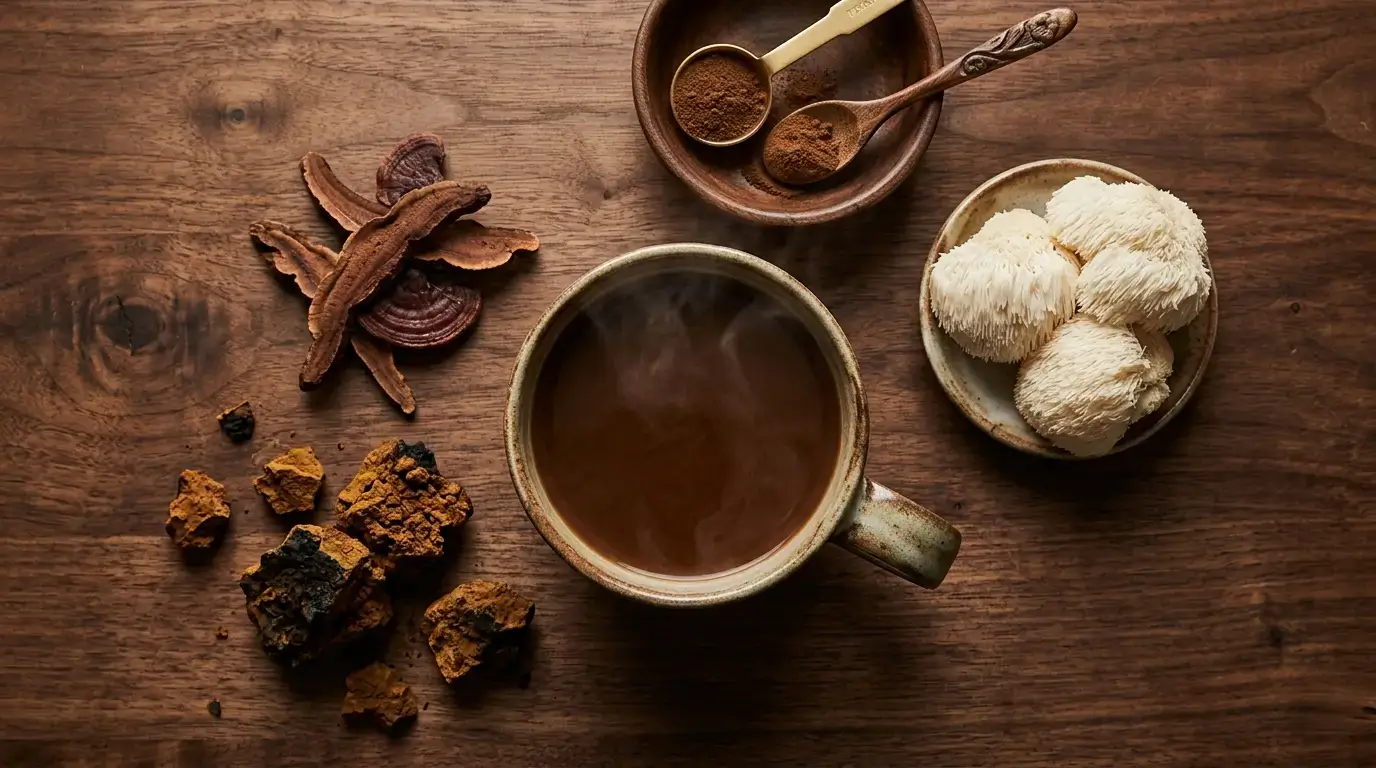
Mushroom coffee has become a popular alternative to traditional coffee, combining coffee beans with extracts or powders from mushrooms such as lion’s mane, reishi, chaga and cordyceps.
Supporters claim that mushroom coffee can improve focus, support immunity, reduce inflammation, provide smoother energy and even help with stress.
But does mushroom coffee actually have health benefits?
The answer is more complicated than many product labels suggest.
Some mushrooms used in these drinks contain interesting compounds and have been studied individually. However, research specifically testing mushroom coffee as a finished beverage in humans remains limited.
This guide explains what mushroom coffee is, what researchers know about its ingredients, which benefits remain uncertain, possible side effects, and how mushroom coffee compares with supplements and regular coffee.
What Is Mushroom Coffee?
Mushroom coffee usually combines coffee with mushroom powders or extracts.
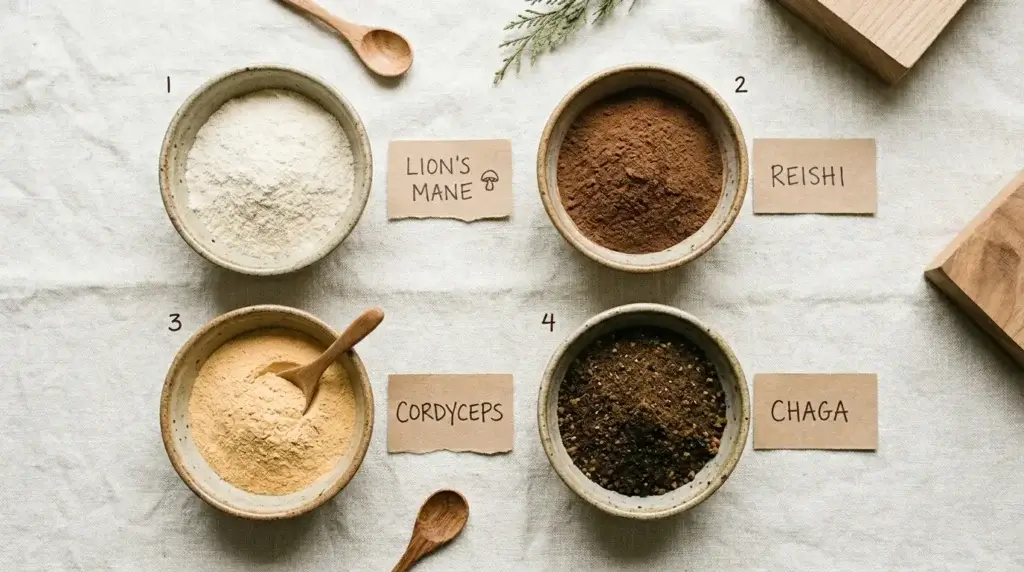
Common mushrooms used in these products include:
- Lion’s mane (Hericium erinaceus)
- Reishi (Ganoderma lucidum)
- Chaga (Inonotus obliquus)
- Cordyceps
- Turkey tail (Trametes versicolor)
Despite the name, mushroom coffee generally doesn’t taste like culinary mushrooms.
Depending on the product, it may taste similar to regular coffee with a somewhat earthy or nutty flavor.
The exact formulation varies considerably between brands. Some contain one mushroom species, while others contain blends of several mushrooms along with coffee, cacao, spices or other ingredients.
That variation is important because there is no single standardized formula called “mushroom coffee.”
Does Mushroom Coffee Really Have Health Benefits?
This is the most important question.
Medicinal mushrooms contain compounds that researchers are studying for possible effects on inflammation, oxidative stress, immune function and other biological processes.
However, there is an important difference between:
research on an individual mushroom or concentrated extract
and
research showing that a cup of commercial mushroom coffee produces the same effect.
At present, the second category is much less established.
Harvard Health notes that well-designed human clinical trials are lacking and that research on medicinal mushrooms hasn’t demonstrated that their proposed benefits necessarily remain after processing and blending them into mushroom coffee. Harvard Health
So it’s more accurate to describe many mushroom-coffee benefits as possible or proposed benefits based on its ingredients, rather than proven effects of the beverage itself.
1. Lion’s Mane and Cognitive Function
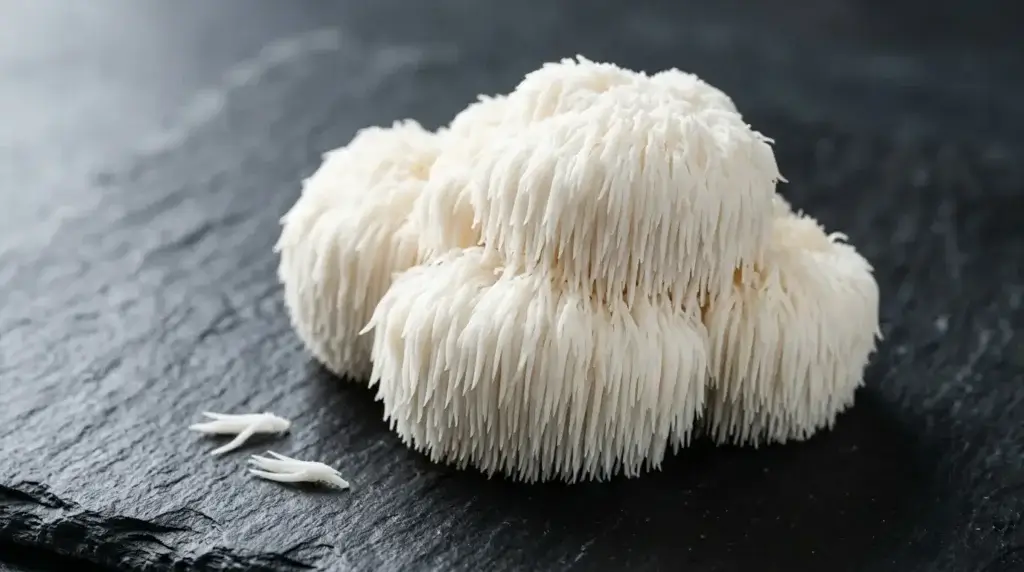
Lion’s mane is one of the most recognizable ingredients in mushroom coffee.
It contains compounds that have attracted scientific interest because of their potential effects on the nervous system.
Some small human studies have investigated lion’s mane in relation to cognitive performance, while laboratory and animal studies have explored mechanisms involving nerve growth.
However, human evidence remains limited.
Cleveland Clinic notes that some research has reported modest cognitive improvements in certain participants, but substantially more research is needed before reliable conclusions can be made about long-term brain benefits. Cleveland Clinic
There’s another important limitation:
Studies investigating lion’s mane generally use a specific mushroom preparation—not necessarily the amount or formulation found in a cup of mushroom coffee.
Does Lion’s Mane Coffee Improve Focus?
Possibly, but it hasn’t been established that typical mushroom-coffee products improve concentration or memory.
Coffee itself contains caffeine, which can temporarily increase alertness.
That makes it particularly difficult to determine whether someone who feels more focused after drinking mushroom coffee is responding to caffeine, the mushroom ingredients, expectations, or some combination of factors.
2. Reishi and Stress
Reishi is frequently included in mushroom coffee products marketed for stress management or “calm energy.”
Reishi contains compounds such as polysaccharides and triterpenes that researchers have investigated for various biological effects.
But claims that reishi in coffee:
- reduces cortisol,
- prevents caffeine jitters,
- improves sleep,
- or creates smoother energy
should be treated cautiously.
Research on reishi itself doesn’t establish that a typical mushroom-coffee serving will produce those effects.
And if the drink contains caffeine, it can still affect sleep or cause unwanted stimulant effects in caffeine-sensitive people.
3. Cordyceps and Exercise Performance
Cordyceps is another common functional-mushroom ingredient.
It has been studied in connection with exercise performance, fatigue and energy metabolism.
Some small studies have produced interesting results, while others haven’t demonstrated clear improvements.
Cleveland Clinic notes that evidence remains mixed and that more human research is necessary to understand whether cordyceps meaningfully improves exercise performance. Cleveland Clinic
This means a mushroom coffee containing cordyceps shouldn’t automatically be considered a performance-enhancing or pre-workout drink.
4. Chaga and Antioxidants
Chaga contains several naturally occurring compounds that have been investigated for antioxidant activity.
Much of the research, however, comes from laboratory or animal studies rather than large human clinical trials.
This distinction matters.
Showing that a compound has antioxidant activity in a laboratory doesn’t automatically demonstrate that drinking mushroom coffee containing that ingredient produces a measurable health benefit in humans.
Chaga also deserves additional attention because of its oxalate content, which we’ll discuss in the safety section below.
5. Does Mushroom Coffee Reduce Inflammation?
This is another question appearing in searches for mushroom coffee.
Some mushrooms contain compounds that demonstrate anti-inflammatory activity in laboratory or animal research.
But that doesn’t establish that mushroom coffee itself is an effective treatment for inflammation.
Harvard Health notes that while medicinal mushrooms have interesting biological properties, there is little human research demonstrating that mushroom coffee delivers the health benefits frequently claimed for it. Harvard Health
Therefore, mushroom coffee shouldn’t be used to treat an inflammatory condition.
Mushroom Coffee vs Regular Coffee
One reason people switch to mushroom coffee is caffeine.

Some mushroom-coffee products contain less caffeine than an equivalent serving of conventional coffee because part of the product consists of mushroom ingredients rather than coffee.
But this isn’t universal.
Always check the product label.
| Mushroom Coffee | Regular Coffee |
|---|---|
| May contain mushroom extracts or powders | Primarily brewed coffee |
| Caffeine varies by product | Caffeine varies by beans and preparation |
| Often marketed as a functional beverage | Extensively studied as coffee |
| Usually more expensive | Generally less expensive |
| Health claims often rely on ingredient research | Large body of coffee research |
| Formula varies considerably between brands | Composition is more predictable |
Neither option is automatically healthier.
If a mushroom-coffee product contains less caffeine and you’re trying to reduce caffeine intake, that particular formulation could be useful.
But you don’t need mushroom coffee to reduce caffeine—you could also drink less coffee, mix regular and decaf, or choose decaffeinated coffee.
Does Mushroom Coffee Cause Fewer Jitters?
Possibly—but mainly if the product contains less caffeine than the coffee you normally drink.
It shouldn’t be assumed that mushroom ingredients themselves neutralize caffeine or prevent anxiety.
Caffeine sensitivity varies considerably between people.
If switching from a high-caffeine coffee to a lower-caffeine mushroom coffee makes you feel less jittery, the reduced caffeine itself may explain the difference.
Mushroom Coffee vs Supplements
This is an important distinction because Google is already showing your page for searches around mushroom coffee vs supplements.
Mushroom coffee and mushroom supplements aren’t equivalent.
A supplement may contain a concentrated amount of one mushroom or extract, whereas mushroom coffee may contain smaller amounts of several ingredients.
Products also vary in:
- mushroom species,
- processing method,
- extract concentration,
- serving size,
- additional ingredients,
- and caffeine content.
Research conducted using a particular mushroom extract at a particular amount therefore can’t automatically be applied to every mushroom-coffee product.
Is a Supplement Better Than Mushroom Coffee?
Not necessarily.
A higher concentration doesn’t automatically mean greater benefit, and supplements can introduce their own questions about quality, interactions and appropriate use.
If you’re considering concentrated mushroom supplements specifically for a health purpose, it’s better to discuss that goal with an appropriate healthcare professional rather than assuming that a larger amount will work better.
Mushroom Coffee Benefits for Women
There isn’t strong evidence showing that mushroom coffee provides unique benefits specifically for women.
Claims involving hormones, fertility, menopause or female metabolism require much stronger evidence than is currently available for mushroom coffee.
Women can evaluate the drink using the same general considerations as anyone else:
- caffeine tolerance,
- ingredients,
- medications,
- medical conditions,
- pregnancy or breastfeeding,
- and personal preference.
This is one area where marketing claims should not be confused with established clinical evidence.
Mushroom Coffee Benefits for Men
Similarly, there’s no strong evidence that mushroom coffee produces unique benefits specifically for men.
Claims involving testosterone, male hormones or sexual performance shouldn’t be assumed based simply on the presence of functional mushrooms.
Current evidence doesn’t justify treating mushroom coffee as a male-health supplement.
Mushroom Coffee and Gut Health
Some mushrooms contain polysaccharides and other compounds that are being studied for interactions with the gut microbiome.
However, mushroom coffee shouldn’t automatically be described as a prebiotic treatment or gut-health therapy.
Processing methods vary, and the quantity of mushroom material in commercial drinks varies considerably.
If gut health is your primary interest, our gut health drinks guide explains several beverage categories and the evidence behind them.
Mushroom Coffee Side Effects
Mushroom coffee isn’t automatically risk-free simply because its ingredients are natural.
Potential issues depend on the mushrooms used, the amount consumed, the caffeine content and individual health circumstances.
Digestive Symptoms
Some people may experience digestive discomfort from mushroom products.
If a new mushroom-coffee product causes persistent digestive symptoms, stop using it and consider discussing the reaction with a healthcare professional.
Chaga and Kidney Stones
Chaga deserves particular caution because it can contain high levels of oxalates.
High oxalate exposure can be relevant for people with kidney disease or a history of certain kidney stones.
Cleveland Clinic specifically notes concerns about chaga and kidney stones. Cleveland Clinic
People with kidney problems shouldn’t assume that a mushroom drink is safe simply because it’s sold as a wellness beverage.
Medication Interactions
Functional mushrooms can contain biologically active compounds.
Depending on the mushroom and preparation, there may be concerns about interactions with medications or effects relevant to blood clotting, blood sugar or immune function.
If you take prescription medications or have a chronic medical condition, discuss concentrated mushroom products with an appropriate healthcare professional.
Mushroom Allergies
People with known mushroom allergies should be particularly cautious with products containing mushroom extracts or powders.
Pregnancy and Breastfeeding
Safety data for many concentrated functional-mushroom preparations during pregnancy and breastfeeding are limited.
Rather than assuming they’re safe because they’re natural, discuss these products with a healthcare professional.
What Should You Look for When Choosing Mushroom Coffee?
Instead of trying to identify one universal “best mushroom coffee,” focus on transparency.
Check whether the label clearly identifies:
- Which mushrooms are included
- How much caffeine the serving contains
- Whether amounts of mushroom ingredients are disclosed
- Other added ingredients
- Added sugar
- Serving size
- Allergen information
Be cautious when a product promises dramatic improvements in memory, immunity, metabolism, hormones or disease prevention.
Those claims go beyond what current mushroom-coffee research can establish.
Do You Need Fruiting Body Mushroom Extracts?
You’ll frequently see claims that fruiting-body extracts are always superior to mycelium products.
The reality is more nuanced.
Different mushroom species contain different compounds in different parts of the organism, and extraction and manufacturing methods also matter.
Rather than assuming one label term guarantees effectiveness, look for transparent ingredient information and reputable manufacturing practices.
Most importantly, don’t use marketing terminology as a substitute for evidence that the finished product actually produces a particular health outcome.
How to Make Mushroom Coffee at Home
The simplest approach is to use a commercially prepared mushroom-coffee blend according to its package instructions.

You can prepare it similarly to other instant or brewed coffee products, depending on the formulation.
For example:
Simple Mushroom Coffee Latte
- 1 serving mushroom coffee prepared according to the package
- Milk or unsweetened plant-based milk
- Cinnamon, optional
Prepare the mushroom coffee according to the manufacturer’s directions.
Add warmed milk and froth if desired.
Finish with cinnamon for flavor.
This approach is preferable to improvising combinations of concentrated mushroom extracts because product strengths and formulations vary substantially.
Is Mushroom Coffee Actually Good for You?

It can fit into an overall balanced diet for some people, but the evidence doesn’t justify calling mushroom coffee a proven health-enhancing beverage.
The mushrooms commonly used in these products are scientifically interesting.
Some have preliminary human research behind particular compounds or preparations.
But there is still a major evidence gap between:
“this mushroom has been studied”
and
“drinking this commercial mushroom-coffee blend produces the same health benefit.”
Harvard Health similarly concludes that well-designed human clinical trials on mushroom coffee are lacking. Harvard Health
That’s the distinction consumers should keep in mind.
Is Mushroom Coffee Worth It?
That depends largely on why you’re buying it.
It may make sense if:
- You enjoy the taste.
- You want to try a different coffee beverage.
- The product contains less caffeine and you want to reduce caffeine intake.
- You understand that many health claims remain uncertain.
It may be less compelling if you’re purchasing an expensive product specifically because you expect it to improve memory, immunity, inflammation or athletic performance.
Current research doesn’t establish those outcomes for mushroom coffee itself.
Frequently Asked Questions
What are the benefits of mushroom coffee?
Mushroom coffee combines coffee with mushroom ingredients such as lion’s mane, reishi, chaga or cordyceps. These mushrooms contain compounds being studied for various biological effects, but research specifically demonstrating health benefits from mushroom coffee itself remains limited.
Does mushroom coffee actually work?
That depends on what you mean by “work.” It functions as a coffee beverage and may contain less caffeine than regular coffee, depending on the product. Claims about improved cognition, immunity, stress or inflammation are much less established for mushroom coffee itself.
Is mushroom coffee good for you?
Mushroom coffee can fit into a balanced diet for some people, but it hasn’t been proven to provide the broad health benefits frequently promoted in marketing.
What does mushroom coffee do for you?
Its most predictable effects may come from its caffeine content. Mushroom ingredients contain compounds being researched for other potential effects, but those findings can’t automatically be applied to mushroom coffee products.
Does mushroom coffee help with inflammation?
Some medicinal mushrooms contain compounds with anti-inflammatory activity in laboratory or animal research. There isn’t enough evidence to conclude that drinking mushroom coffee meaningfully reduces inflammation in humans.
Is mushroom coffee better than regular coffee?
Neither is universally better. Mushroom coffee may contain less caffeine depending on the product, while regular coffee has a much larger body of research behind it. Taste, caffeine tolerance, price and personal preference all matter.
Does mushroom coffee have side effects?
It can. Potential concerns include digestive symptoms, caffeine-related effects, mushroom allergies and ingredient-specific risks. Chaga, for example, can contain high levels of oxalates, which may be relevant for people with kidney problems.
Can you drink mushroom coffee every day?
There isn’t one recommendation appropriate for everyone. Consider the caffeine content, mushroom ingredients, your medications and medical conditions, and how you tolerate the product.
Is mushroom coffee better than mushroom supplements?
They’re different products. Supplements may provide more concentrated amounts of particular ingredients, while mushroom coffee combines mushrooms with a beverage. A higher concentration doesn’t automatically mean a better health outcome.
Does mushroom coffee have benefits for women?
There isn’t strong evidence that mushroom coffee has unique benefits specifically for women. Claims involving hormones, fertility or menopause aren’t well established for mushroom coffee.
Does mushroom coffee have benefits for men?
There isn’t strong evidence of mushroom-coffee benefits unique to men, including claims involving testosterone or male hormones.
The Bottom Line
Mushroom coffee is an interesting functional beverage, but its reputation currently runs ahead of the research.
Lion’s mane, reishi, chaga, cordyceps and other mushrooms contain compounds worthy of scientific investigation. Some have preliminary human evidence, while much of the broader research still comes from laboratory, animal or small human studies.
What we don’t yet have is strong evidence showing that typical commercial mushroom-coffee products reliably improve focus, immunity, inflammation, stress or physical performance.
That doesn’t make mushroom coffee useless.
If you enjoy it, tolerate its ingredients and prefer its caffeine level, it can simply be another beverage option.
The important thing is to separate the research on individual mushroom ingredients from the much stronger claims sometimes made about the finished drink.