
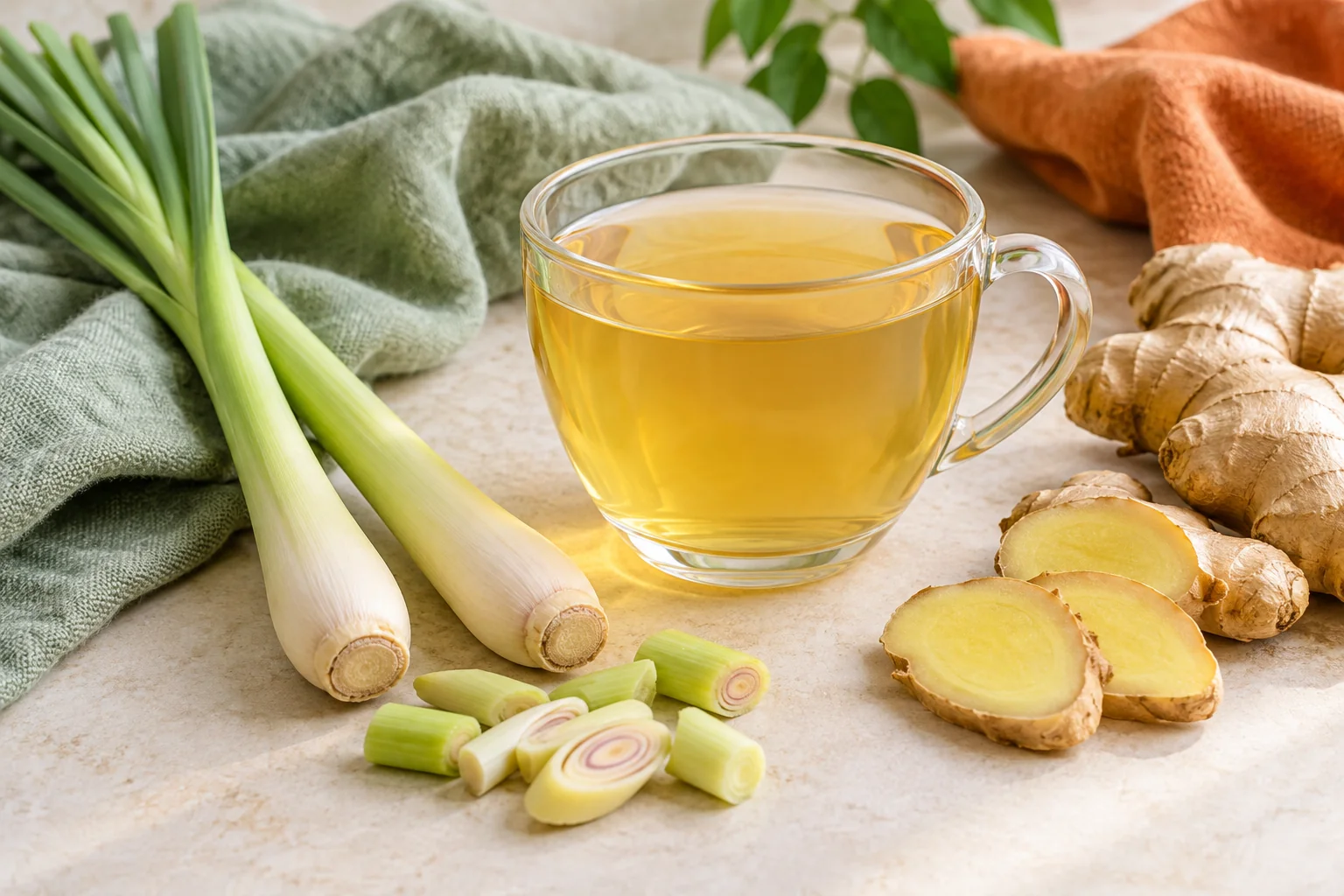
Lemongrass ginger tea is an herbal infusion made by gently simmering culinary lemongrass and fresh ginger in water, then straining out the fibrous pieces. This two-cup recipe starts with one medium lemongrass stalk, 10 grams of sliced ginger, and 500 milliliters of water. The base drink contains no tea leaves and is naturally caffeine-free.
Lemongrass gives the cup a citrus-like aroma, while ginger adds a peppery note. You do not need lemon juice to get the aromatic character, although a small squeeze can be added after brewing if you like a sharper finish.
The main preparation detail is handling the lemongrass properly. Remove tough outer layers, bruise the usable lower stalk, cut it into manageable pieces, and strain thoroughly. Those steps make a more practical infusion than dropping an intact stalk into a mug and hoping for the best.
If you prefer actual lemon juice as the main citrus ingredient, try our lemon ginger tea recipe. This guide focuses on fresh lemongrass, its preparation, and a repeatable herbal method.
What Is Lemongrass Ginger Tea?
It is a tisane made from culinary lemongrass, ginger, and water. The word tea is commonly used for the finished drink even though the base recipe does not include green or black tea leaves.
That distinction matters when choosing a caffeine-free beverage. A product containing green tea alongside lemongrass and ginger is a different blend, with different brewing requirements.
The flavor also differs from lemon ginger tea. Lemongrass contributes fragrance without requiring squeezed citrus juice. Lemon juice contributes acidity as well as flavor. The ingredients can be combined, but they are not identical substitutes in every recipe.
A Recipe With Cultural Connections, Not a Claim of Authenticity
Lemongrass and ginger appear together in drinks and cooking across different culinary traditions. Recipes differ in strength, sweetness, additional herbs, and serving style.
The version here is a simple contemporary home infusion. It is not presented as the single authentic preparation of a traditional regional drink. If you are looking for a specific named drink, its ingredients and method deserve their own treatment.
Ingredients and Equipment
You need a small saucepan, knife, cutting board, measuring jug, and fine-mesh strainer. A kitchen scale helps keep the ginger quantity consistent.
| Ingredient | Starting amount | Role |
|---|---|---|
| Drinking water | 500 ml, about 2 cups | Infusion base |
| Culinary lemongrass | 1 medium stalk, about 20 g after trimming | Citrus-like aroma |
| Fresh ginger | 10 g, thinly sliced | Peppery flavor |
| Honey or maple syrup | Optional, 1 tsp for the batch | Sweetness |
| Lemon or lime juice | Optional, a small squeeze after brewing | Added acidity |
The stalk weight is approximate because lemongrass varies in thickness and usable length. The measurements describe a culinary starting point, not a standardized herbal supplement or a medical dose.
Choosing Culinary Lemongrass
Buy lemongrass sold for cooking from a food retailer. Look for stalks that feel firm and smell aromatic when cut or bruised. Very dried-out stalks may give a less satisfying result.
Do not assume that any plant with a lemony smell is an appropriate substitute. Use ingredients intended for food preparation rather than ornamental grasses or materials you cannot identify confidently.
This recipe uses stalks, not lemongrass essential oil. Essential oils are not interchangeable with culinary plant ingredients, and a few drops should not be added as a shortcut to the recipe.
Choosing the Ginger
Use a firm piece of fresh ginger with no mold or spoiled areas. Wash it before cutting, and remove damaged sections. Peeling is optional for sound, thoroughly washed ginger, but it may be convenient if the skin is thick.
Slice thinly so the infusion is reasonably consistent from one batch to another. If you grate it, expect more fibers and use a fine strainer at the end.
How to Prepare Lemongrass for Tea

1. Wash and Trim
Rinse the stalk under running water. Trim off the very bottom and any damaged areas. Remove tough or dry outer layers until you reach the cleaner, more usable inner stalk.
The lower pale section is a convenient part to use for this small recipe. A whole long stalk can be awkward to handle in a saucepan, so do not force it into the pan simply to avoid trimming.
2. Bruise the Stalk
Press the usable stalk gently with the side of a broad knife or another suitable kitchen tool on a stable cutting board. Keep your fingers away from the blade, and do not strike the stalk with the sharp cutting edge.
The goal is to break up the firm structure enough to expose it to the water. It does not need to become a paste.
3. Cut Into Short Pieces
Cut the bruised stalk into short lengths that fit comfortably in your saucepan. Pieces around 2 to 3 centimeters long are convenient for this infusion because they are manageable and easy to remove afterward.
Very finely minced lemongrass is useful in other kinds of recipes but is less convenient here. It creates more small, fibrous fragments to strain out of a drink.
4. Keep Straining in Mind
Lemongrass is fibrous. Prepare the strainer before you start pouring hot liquid so you are not trying to improvise while holding a saucepan.
The finished tea should be a strained infusion rather than a drink full of woody pieces. A garnish can be added separately for appearance, but there is no need to leave the simmered fragments in the mug.
How to Make Lemongrass Ginger Tea
Simmer the Aromatics
Put the prepared lemongrass, 10 grams of sliced ginger, and 500 milliliters of drinking water in a small saucepan. Bring just to a boil, then reduce to a gentle simmer.
Simmer for approximately 10 minutes. Keep the heat moderate so the water does not evaporate too quickly. A vigorous rolling boil can reduce the volume substantially and make the final cup stronger than intended.
Check the Flavor
Taste a spoonful after allowing it to cool. If the ginger is already stronger than you like, strain the infusion rather than continuing to simmer out of habit.
If the flavor seems light, you can leave the aromatics in the hot water briefly after turning off the heat. Record what you change so you can repeat a version you enjoy.
Strain and Finish
Pour through a fine-mesh strainer into a heat-safe jug. Stir in optional sweetness or a small squeeze of citrus only after tasting the base drink.
Divide between two cups. Let the tea cool to a comfortable temperature before sipping. Dilute with plain hot water if either the ginger or lemongrass is too intense.
Lemongrass Ginger Tea Recipe
Print
Lemongrass Ginger Tea
Strained culinary lemongrass and fresh-ginger infusion with optional sweetness or citrus.
- Total Time: 15 minutes
- Yield: 2 small cups 1x
Ingredients
500 ml drinking water, about 2 cups
1 medium culinary lemongrass stalk, about 20 g after trimming, bruised and cut into short pieces
10 g fresh ginger, washed and thinly sliced
1 tsp honey or maple syrup for the batch, optional
A small squeeze of lemon or lime juice after brewing, optional
Instructions
1. Wash the lemongrass. Trim the base and damaged areas, remove tough outer layers, bruise the usable stalk, and cut it into short pieces.
2. Add the lemongrass, sliced ginger, and water to a small saucepan.
3. Bring just to a boil, reduce the heat, and simmer gently for approximately 10 minutes.
4. Taste a cooled spoonful, then strain the infusion into a heat-safe jug.
5. Add optional sweetness or citrus gradually. Divide into two cups and serve at a comfortable drinking temperature.
Notes
Use culinary stalks rather than essential oil. Strain out fibrous pieces. Omit honey or use maple syrup for a vegan version. Ingredient amounts are flavor proportions, not a therapeutic dose.
- Prep Time: 5 minutes
- Cook Time: 10 minutes
- Category: Drinks
- Method: Stovetop infusion
Keywords: lemongrass ginger tea, lemongrass and ginger tea
Fresh, Frozen, or Dried Lemongrass?
Fresh stalks make it easy to see what you are preparing and to adjust the amount. They are a useful starting point when you are unfamiliar with the ingredient.
Frozen culinary lemongrass can be convenient when fresh stalks are hard to find. Follow the storage and handling directions on the package, and check whether it is supplied as whole pieces, chopped stalks, or a mixed preparation.
Dried lemongrass is a different ingredient form. Do not replace a fresh stalk with the same volume of dried material without checking the product instructions. The cut size, dryness, and density vary, so a universal conversion would be misleading.
A commercial tea bag is another option. Look at the full list: it may contain lemongrass and ginger alone, or it may also include tea leaves, licorice, flavorings, or additional herbs. Follow its directions rather than applying this stovetop method automatically.
How to Balance Lemongrass and Ginger
The best proportion depends on whether you want a ginger-forward cup or a lighter aromatic infusion. Start with the base recipe before making large changes.
| Your goal | Adjustment for a future batch |
|---|---|
| Less peppery | Use less ginger or a shorter ginger infusion |
| More lemongrass aroma | Prepare the stalk carefully and modestly increase its usable amount |
| Less concentrated | Reduce evaporation or add water after straining |
| More citrus acidity | Add a small amount of lemon or lime juice at the end |
| No added sweetness | Omit honey and maple syrup |
| Smoother texture | Use a finer strainer and larger removable stalk pieces |
Change one thing at a time. Doubling the ginger, increasing the stalk count, and extending the simmer together can create a drink that is difficult to compare with your first batch.
Also remember that a more powerful aroma does not establish a larger health benefit. Adjust the recipe for enjoyment rather than trying to make a medicinal-strength cup.
Variations to Try
Lemongrass Ginger Tea With Lemon or Lime
Add a small squeeze after straining and taste again. Because lemongrass already has a citrus-like fragrance, you may need less juice than you expect.
If the drink becomes too sour, dilute it rather than repeatedly adding more sweetener. For a recipe centered on actual lemon juice, use the lemon ginger tea method.
An Unsweetened Version
The base infusion does not require honey, sugar, or syrup. If you prefer a gentle cup without sweetness, begin with less ginger rather than making a sharp brew and trying to mask it afterward.
Sweetness is a preference, not proof that the recipe becomes more nourishing or more effective for a symptom. Measure it if you use it so the next batch can taste similar.
Lemongrass Ginger Green Tea
Adding green tea creates a different beverage that can contain caffeine. Make and strain the herbal infusion first, then brew the leaves according to the product’s instructions.
Our green tea with ginger guide explains why the leaf-brewing stage should be kept separate from the ginger simmer. Apply the same principle rather than boiling the leaves throughout the entire herbal preparation.
How to Make an Iced Version
Prepare and strain the infusion, then refrigerate it promptly in a clean covered container. Add citrus or optional sweetness according to taste and serve chilled over ice.
Letting the batch chill before pouring helps avoid excessive dilution. If you pour a hot infusion onto a large quantity of ice, much of that ice melts and changes the water-to-ingredient balance.
For a small pitcher, scale the ingredients proportionally as a starting point, but check how much liquid remains after simmering. A wider pan may evaporate water differently from the small saucepan used for two cups.
Keep decorative stalks and citrus slices out of the stored batch until serving. This makes straining, pouring, and judging the final flavor simpler.
Does Lemongrass Ginger Tea Have Health Benefits?
This recipe provides an aromatic drink you can make without added sweetness or tea leaves. Those are practical characteristics, not evidence that the combination treats a medical condition.
Research about an ingredient, an isolated compound, or an extract should not be turned into a broad claim about a homemade infusion. The preparation and outcome need to match.
For an explanation of that distinction, read our ginger tea benefits article. This recipe is not presented as a detox, a fat-burning drink, or a way to prevent chronic disease.
What About Bloating?
If that is your main reason for searching, the evidence question belongs in our focused guide to ginger tea and bloating. Adding lemongrass does not establish that a blend relieves the symptom more reliably.
Treat a cup you enjoy as a beverage. Persistent discomfort needs attention to its cause rather than repeated adjustments to the same herbal recipe.
Storage, Reheating, and Small Batches
Fresh tea is the easiest way to appreciate the aroma. If you make extra, strain it, use a clean covered container, and refrigerate promptly. Prepare only enough for the same day or next day for the best quality.
General food-safety guidance advises prompt refrigeration of perishable preparations and keeping refrigerators at 40°F, or 4°C, or below. Do not leave a fruit-garnished pitcher standing at room temperature overnight.
Warm only the portion you want to drink. Repeatedly boiling a stored batch down can make the drink more concentrated and change its balance. Add citrus after reheating so you can taste and adjust it fresh.
When using an unfamiliar ingredient, two cups are a useful trial batch. You can learn how much aroma and ginger warmth you enjoy without committing to a large pot.
FAQs
Is lemongrass ginger tea caffeine-free?
The base recipe contains lemongrass, ginger, and water without tea leaves, so it is naturally caffeine-free. Blends with green or black tea are different.
Which part of lemongrass should I use for tea?
For this recipe, use the cleaned lower stalk after trimming and removing tough outer layers. Bruise it, cut it into short pieces, and strain after infusion.
Can I use dried lemongrass instead of fresh?
Yes, if it is sold for culinary use, but follow the product’s directions rather than assuming a universal fresh-to-dried conversion. Start with a small batch.
Do I need to add lemon juice?
No. Lemongrass already contributes a citrus-like aroma. Lemon or lime juice is optional and adds acidity, so add it gradually after brewing.
Can I use lemongrass essential oil in the recipe?
No. This recipe uses culinary stalks. Essential oil is a different preparation and should not be substituted for the ingredient specified here.
Can I drink lemongrass ginger tea iced?
Yes. Strain the infusion, refrigerate promptly, and serve chilled over ice. Add optional citrus and sweetness according to taste.