
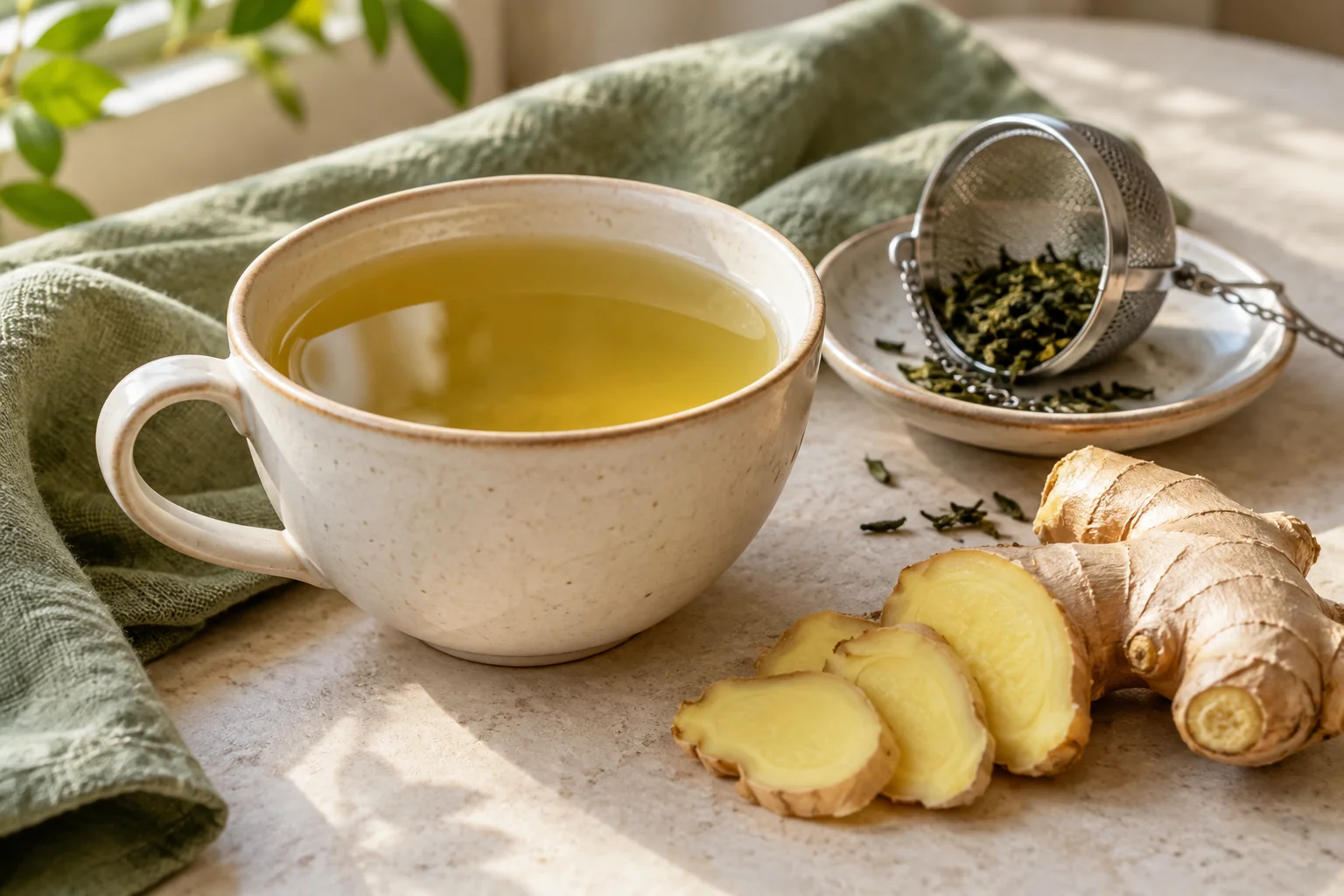
Green tea with ginger combines brewed green tea with a separate fresh-ginger infusion. The easiest way to avoid an overly bitter cup is to simmer the ginger first, remove the saucepan from the heat, then brew the green tea according to its package instructions. This drink contains caffeine unless you choose an appropriate decaffeinated product.
The distinction between the two brewing stages is the key to the recipe. Ginger can take a longer simmer to build the flavor you want, while green tea leaves have their own temperature and steeping requirements. Keeping those stages separate gives you more control over both ingredients.
If you want an herbal drink without tea leaves, use our lemon ginger tea recipe instead. The recipe here is specifically for green tea with ginger, with optional lemon and sweetness added at the end.
What Is Green Tea With Ginger?
It is a tea-leaf beverage flavored with ginger. That makes it different from plain ginger tea, which can be made from ginger and water alone.
The green tea brings its own aroma and a flavor that may be grassy, toasted, floral, or lightly savory, depending on the product. Ginger adds a peppery edge. The goal is a balance where neither ingredient overwhelms the other.
This drink is also different from matcha mixed with ginger. Matcha is powdered tea dispersed in water rather than leaves removed after steeping. You should not substitute it spoon-for-spoon in the method below.
Why the Word Green Does Not Mean Caffeine-Free
Green tea and black tea both come from the tea plant. A lighter color does not show that a beverage contains no caffeine.
Adding ginger does not remove the caffeine already contributed by the tea leaves. Likewise, adding more water changes the concentration in a sip but does not necessarily change the total caffeine in a batch that you drink in full.
For an herbal alternative with a citrus-like aroma, try our lemongrass ginger tea. Its base recipe contains no tea leaves.
Ingredients for Two Small Cups
This recipe uses a modest amount of ginger so you can still taste the green tea. Increase the ginger in a later batch if you prefer a stronger spice note.
| Ingredient | Starting amount | Notes |
|---|---|---|
| Drinking water | 500 ml, about 2 cups | Add a little more if simmering causes evaporation |
| Fresh ginger | 8 g, washed and thinly sliced | A culinary flavor amount |
| Green tea | 2 tea bags | Follow the product’s brewing directions |
| Lemon juice | Optional, 1 tsp for the batch | Add after brewing |
| Honey | Optional, 1 tsp for the batch | Taste before adding |
A small saucepan, measuring jug, strainer, and heat-safe mugs are enough. A thermometer helps if your tea specifies a brewing temperature, but the package instructions remain the best starting point for that product.
Which Green Tea Should You Use?
Choose a plain green tea you already enjoy. A simple product makes it easier to notice what ginger contributes. A heavily flavored blend can work, but its citrus, mint, or spice ingredients may compete with the ginger.
Tea bags are convenient because they are easy to remove at the end of steeping. Loose leaves are equally possible if you have an infuser or fine strainer. Use the amount the producer recommends for your water volume.
Brewing advice varies. For example, Twinings’ directions for its Pure Green Tea specify freshly boiled water and a three-minute infusion. Other products recommend cooler water. Do not treat one temperature as a rule for every green tea.
Preparing the Ginger
Wash the ginger, remove any damaged areas, and cut it into thin slices. Peeling is optional for a sound, thoroughly washed piece, although thicker skin can be removed if you prefer.
Thin slices make the starting method more repeatable than large chunks. Grating gives a different texture and leaves more particles to strain, so sliced ginger is a convenient first choice.
Use a scale if you want to reproduce the same cup. A length measurement such as one inch can vary because ginger pieces have different widths and shapes.
How to Make Green Tea With Ginger
1. Make the Ginger Infusion
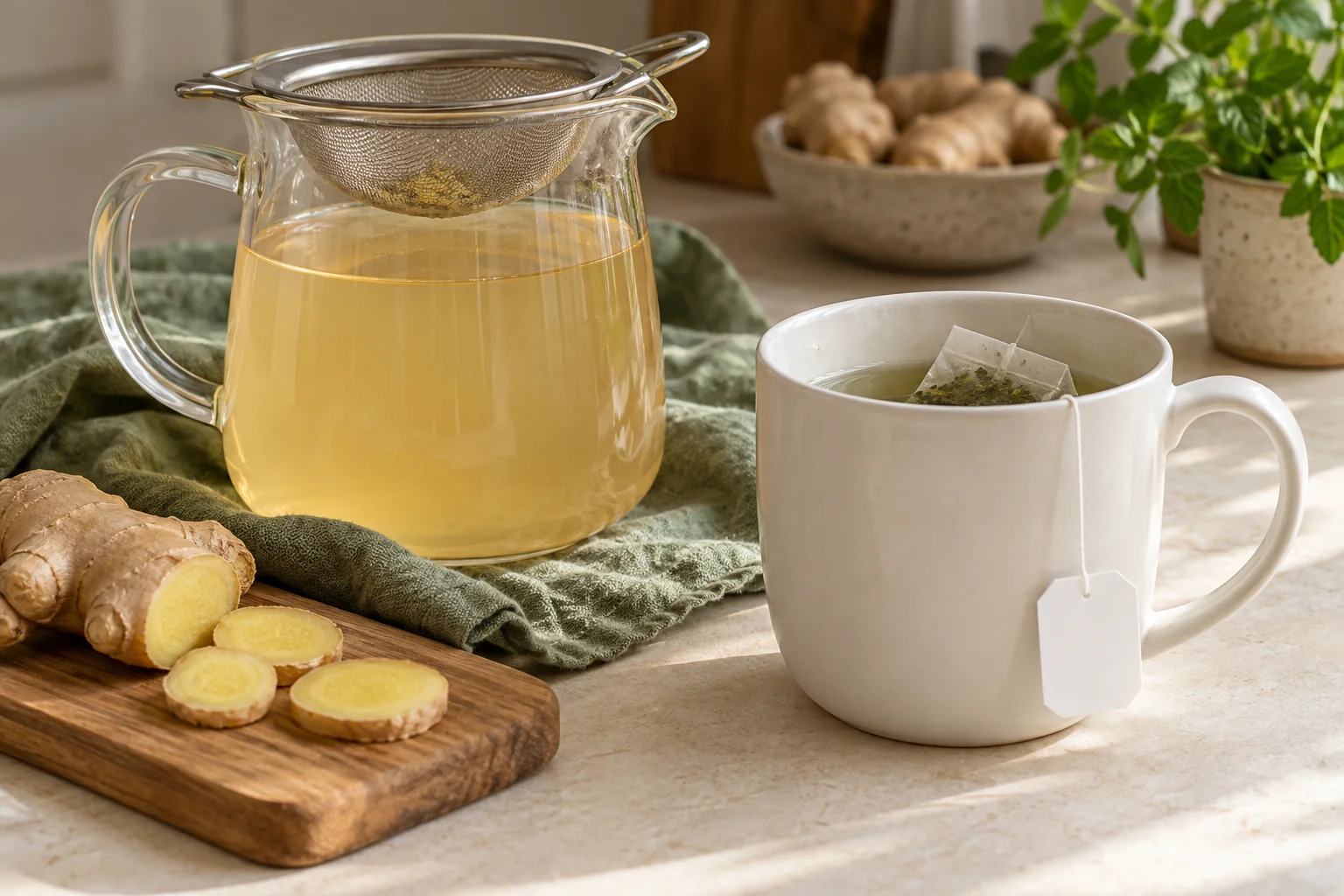
Put 8 grams of sliced ginger and 500 milliliters of water in a small saucepan. Bring just to a boil, then reduce the heat and simmer gently for 5 minutes.
At this stage, do not add the green tea. You are building the ginger base without extending the tea leaves’ steeping time.
2. Remove the Ginger and Adjust the Water
Take the pan off the heat and strain out the ginger into a heat-safe jug. If substantial liquid has evaporated, add a little water to bring the batch back toward 500 milliliters.
Taste a cooled spoonful if you want to check the spice level. Dilute the ginger base now if it is already stronger than you would enjoy, before adding another flavor.
3. Brew the Green Tea
Bring the ginger infusion to the temperature recommended on your tea package, allowing it to cool if necessary. Add the two tea bags and steep for the package’s suggested time.
If your product supplies no guidance, a short steep is a sensible tasting experiment rather than a reason to leave the leaves in indefinitely. Start gently and adjust in your next cup according to the tea’s flavor.
Remove the bags or loose leaves when brewing is complete. You can now adjust the drink without continuing to extract tea flavor.
4. Add Optional Lemon and Honey
Stir in 1 teaspoon of lemon juice for the batch if desired. Taste before adding honey. Start with a small amount so the tea remains a ginger-green-tea drink rather than a sweet lemon beverage with a little tea in it.
Lemon and honey are flavor choices. Neither is required for the recipe, and neither establishes that the combination has a special detoxifying effect.
5. Serve
Divide between two small cups and let cool to a comfortable drinking temperature. If the finished drink is too intense, dilute with a little warm water rather than masking it with increasing amounts of sweetener.
Green Tea With Ginger Recipe
Print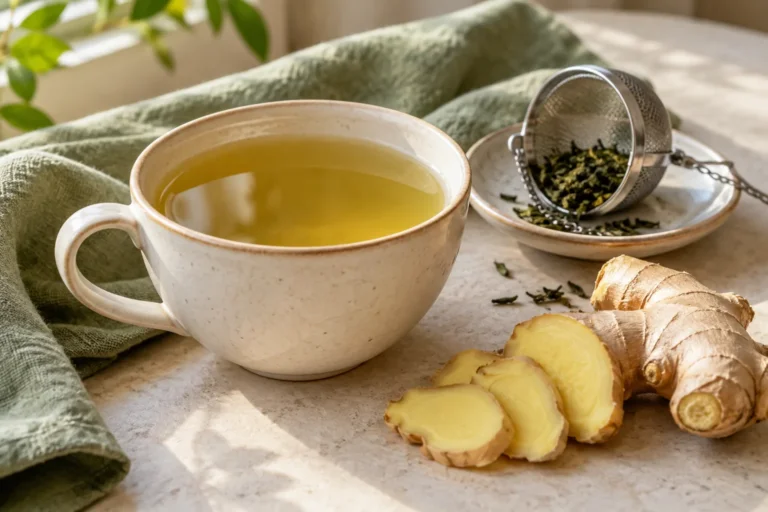
Green Tea With Ginger
Green tea brewed in a separate fresh-ginger infusion, with optional lemon and honey. Contains caffeine unless a suitable decaffeinated product is used.
- Total Time: 15 minutes
- Yield: 2 small cups 1x
Ingredients
500 ml drinking water, about 2 cups
8 g fresh ginger, washed and thinly sliced
2 green tea bags, or the loose-leaf amount recommended for 500 ml
1 tsp lemon juice for the batch, optional
1 tsp honey for the batch, optional
Instructions
1. Put the water and ginger in a small saucepan. Bring just to a boil, then simmer gently for 5 minutes.
2. Remove from the heat and strain into a heat-safe jug. Replace a little evaporated water if needed.
3. Adjust the infusion to the brewing temperature recommended for your green tea.
4. Add the tea bags and steep according to the package, then remove them.
5. Add optional lemon juice and honey, tasting as you go. Divide into two cups and serve at a comfortable temperature.
Notes
Cooling and steeping times depend on your tea product; total time is approximate. This recipe contains caffeine unless suitable decaffeinated tea is used, and even decaffeinated products can retain some caffeine.
- Prep Time: 5 minutes
- Cook Time: 10 minutes
- Category: Drinks
- Method: Stovetop infusion and tea steeping
Keywords: green tea with ginger, ginger green tea
How Much Caffeine Does It Contain?
The amount varies with the tea product, the amount of leaf, the serving size, and preparation. The FDA’s caffeine guide lists 37 milligrams as a typical amount for a 12-fluid-ounce green tea. That is a general reference value, not a measurement of this recipe.
A small cup is not necessarily comparable to a large café serving, and two brands may differ. If caffeine intake matters for your circumstances, look for product-specific information and count other caffeine sources in your day.
Ginger does not cancel caffeine. A drink can taste more herbal while still containing the caffeine from its tea base.
Can You Make It With Decaffeinated Green Tea?
Yes. Use the product’s instructions and the same separate ginger-infusion method. Decaffeinated does not always mean zero caffeine, so check the labeling if you need to avoid it closely.
If you want to exclude tea leaves entirely, choose one of the herbal recipes in this cluster instead of assuming that a decaffeinated leaf tea is identical to a plain ginger infusion.
Benefits: What This Combination Does and Does Not Establish
The obvious culinary benefit is a different flavor in an ordinary tea. You can also choose to prepare it without added sweetness. Those are practical features that do not require a medical claim.
The NCCIH green tea overview discusses research on green tea and distinguishes beverages from concentrated products such as extracts. Those preparations should not be treated as equivalent, and adding ginger does not establish a clinically proven combination treatment.
For the ginger evidence, our ginger tea benefits guide explains why research on supplements cannot automatically predict an effect from a homemade cup.
Avoid describing this recipe as a guaranteed way to burn fat, clean the liver, or accelerate metabolism. A satisfying drink can fit your routine without those promises.
What About Drinking It After Meals?
Some people enjoy tea after eating because it is a pleasant way to finish a meal. That preference is different from evidence that this particular recipe reliably relieves uncomfortable fullness.
If your main question is digestive symptoms, read our ginger tea and bloating explanation. It examines the evidence question rather than presenting a recipe as a cure.
How to Prevent a Bitter Cup
Start by keeping track of the leaves’ actual time in the water. If the ginger simmers for five minutes and the tea remains in the pan for the whole process, the tea has had a longer extraction than you may realize.
Remove the tea at the end of its own brewing period. Then adjust lemon, sweetness, or serving temperature without continuing to steep the leaves.
| Problem | First adjustment to try |
|---|---|
| Bitter or drying taste | Follow a shorter steep or lower temperature when appropriate for the product |
| Ginger overwhelms tea | Reduce ginger or dilute its infusion before brewing |
| Tea tastes weak | Check the leaf-to-water amount on the package |
| Too sour | Reduce optional lemon juice |
| Too sweet | Omit honey or add less after tasting |
| Different result each time | Measure water, ginger, and steeping time |
A little bitterness may be part of a tea’s character. The aim is not to eliminate every strong note, but to avoid an unexpectedly harsh cup caused by a method you did not intend.
Hot, Iced, and Mint Variations
Iced Green Tea With Ginger
Prepare the recipe, remove the tea leaves, and refrigerate the strained drink promptly in a clean container. Pour over ice when chilled.
If you pour a hot batch over a large glass of ice, the melting ice adds water and changes the recipe strength. Chilling first makes the final balance easier to predict.
Ginger Green Tea With Mint
Add a few washed mint leaves during a brief final infusion, then remove them. Start with a small amount so the mint does not erase the green tea’s character.
This is a flavor variation. It should not be described as increasing a treatment effect simply because another herb is included.
A Lemon Variation
Add lemon juice after brewing, a little at a time. If you want lemon and ginger to dominate the drink, the separate lemon ginger herbal recipe may be a better starting point.
Scaling the Recipe
For a larger batch, scale the water and ginger proportionally as a starting point. Follow the tea package for the amount of leaf rather than guessing that one bag can flavor an entire pitcher.
A bigger saucepan may also lose a different amount of water during simmering. Check the final volume before brewing the green tea so the leaf-to-water ratio remains close to what you intended.
Make a small batch first when using an unfamiliar tea. It is easier to adjust two cups than to correct a large pitcher that is already bitter or too strongly flavored.
Storage and Serving Quality
This drink is simplest to enjoy freshly prepared. If storing an iced batch, remove the ginger and tea leaves, use a clean covered container, and refrigerate promptly. Prepare only enough for the same day or next day for the best quality.
General food-safety guidance advises prompt refrigeration of perishable preparations. Do not leave cut-fruit garnishes sitting in a room-temperature pitcher overnight.
Add garnish at serving time. If reheating, warm only the portion you want and avoid continuing to boil it down. A stored tea can change in taste, so judge flavor separately from assumptions about safety.
FAQs
Does green tea with ginger contain caffeine?
Yes, when made with regular green tea. Ginger does not remove that caffeine. Use product-specific information if the amount matters to you.
Can I simmer the ginger and tea bags together?
You can, but it makes tea steeping harder to control. This recipe simmers ginger first and adds green tea afterward according to the tea’s own instructions.
What temperature should I use for green tea with ginger?
Follow the tea package. Some green teas use cooler water, while other products specify freshly boiled water. The ginger stage and tea stage do not need identical temperatures.
Can I make the recipe without honey?
Yes. Honey is optional, and the unsweetened version still contains ginger and green tea. Add sweetness only if you want it.
Does ginger green tea cause weight loss?
This recipe is not an established weight-loss treatment. Consider it as a beverage choice within your overall routine rather than a guaranteed fat-burning drink.
Can I serve green tea with ginger cold?
Yes. Remove the tea leaves after brewing, refrigerate promptly, and serve chilled over ice. Chilling before adding ice helps control dilution.
2 thoughts on “Green Tea With Ginger: Easy Recipe, Benefits and Caffeine”