
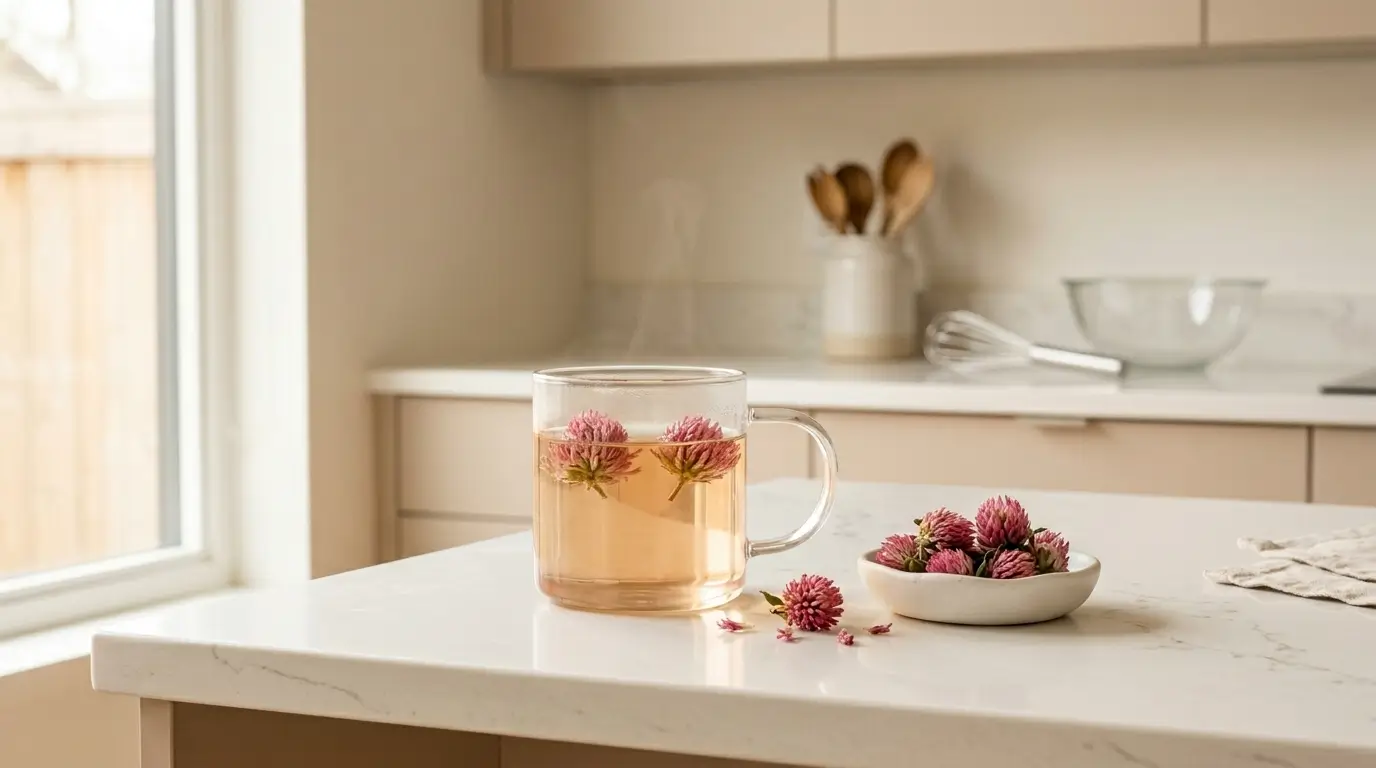
Red clover tea benefits are often discussed in relation to menopause, estrogen and women’s health. Red clover (Trifolium pratense) naturally contains isoflavones, plant compounds that can interact with estrogen receptors in the body.
Most clinical research, however, has studied standardized red clover isoflavone extracts rather than ordinary brewed red clover tea. This distinction matters because the amount and composition of isoflavones in supplements and extracts can differ substantially from what you get in a cup of tea.
Research has explored red clover isoflavones for menopausal symptoms, bone health, cardiovascular markers and other outcomes, but results are not equally strong or consistent across all studies.
In this guide, we’ll look at what red clover tea contains, what research on red clover and its isoflavones actually shows, whether it contains caffeine, its possible relationship with estrogen and menopause, and the important side effects and safety considerations to know.
What Is Red Clover Tea?
Red clover tea is brewed from the dried flower heads of Trifolium pratense — the common red clover, a flowering plant in the legume family (Fabaceae) found throughout Europe, Asia, and naturalized across North America. Red clover tea is brewed from the dried flower heads of Trifolium pratense, a flowering plant in the legume family (Fabaceae). Red clover has a history of use in traditional herbal preparations, while modern research has focused largely on its isoflavone content.
The tea has a mild, slightly sweet, earthy flavor with a gentle floral note. Most people find it pleasant and easy to drink without any sweetener. The color brews to a pale golden-pink.
Does red clover tea have caffeine? No. Red clover tea is completely caffeine-free.
The Active Compounds: Isoflavones
Red clover contains several isoflavones, a group of plant compounds classified as phytoestrogens because they can interact with estrogen receptors in the body.
The main isoflavones found in red clover include:
- Biochanin A
- Formononetin
- Daidzein
- Genistein
Biochanin A and formononetin can be metabolized into other isoflavones, including genistein and daidzein. How these compounds are absorbed and metabolized can vary between individuals.
Isoflavones can interact with estrogen receptors, but this does not mean that they act exactly like the body’s own estrogen or that red clover tea is equivalent to menopausal hormone therapy.
Another important distinction is the form being studied. Much of the clinical research on red clover has used standardized isoflavone extracts, which provide controlled amounts of these compounds. A brewed cup of red clover tea may contain different and less predictable amounts.
Therefore, findings from studies using concentrated red clover extracts should not automatically be attributed to ordinary red clover tea.
1. Red Clover and Menopause Symptoms
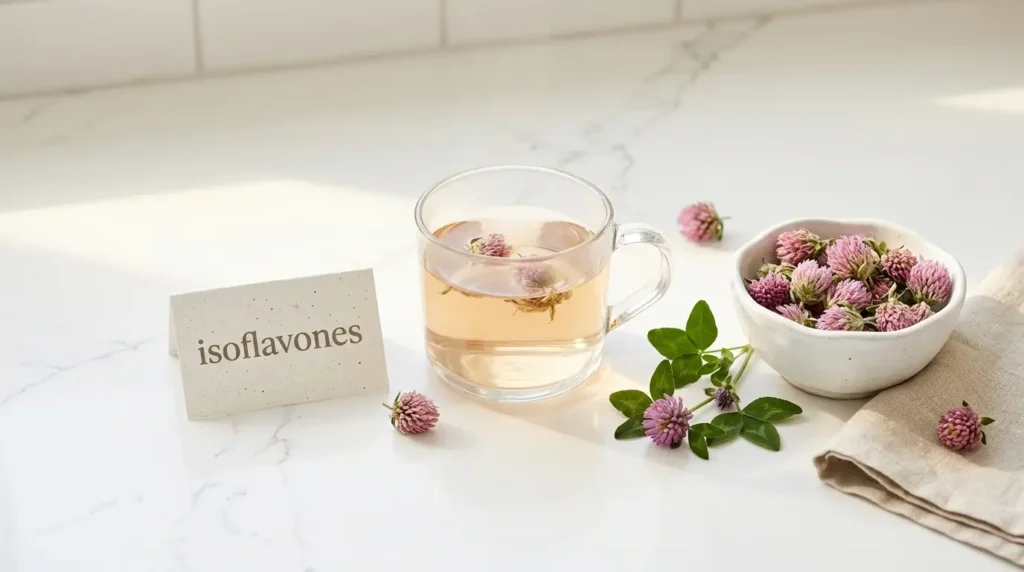
Red clover is most commonly studied in relation to menopause because its isoflavones can interact with estrogen receptors.
Clinical trials and reviews have investigated standardized red clover isoflavone extracts for symptoms such as hot flashes. However, results have been mixed, and not all studies have found a meaningful benefit compared with placebo.
Some individual studies have reported reductions in hot flash frequency, but these findings should be interpreted cautiously because studies differ in the extract used, isoflavone dose, duration and participants.
It is also important to distinguish red clover extract from red clover tea. Most clinical studies investigating menopausal symptoms have used standardized extracts containing measured amounts of isoflavones rather than ordinary brewed tea.
There is currently not enough evidence to determine that drinking red clover tea provides the same effects as the standardized extracts used in clinical trials.
Red clover tea therefore should not be presented as a replacement for menopausal hormone therapy or as a proven treatment for hot flashes, night sweats, mood changes or sleep problems.
2. Red Clover and Bone Health
Bone health becomes increasingly important after menopause because declining estrogen levels are associated with accelerated bone loss and a higher risk of osteoporosis.
Researchers have investigated whether red clover isoflavones may influence markers related to bone health in postmenopausal women. Some studies using standardized isoflavone extracts have reported potentially favorable changes, but the evidence is not sufficient to conclude that red clover prevents osteoporosis or fractures.
Importantly, these studies generally involve standardized red clover extracts rather than brewed red clover tea. The amount of isoflavones delivered by tea can vary depending on the product and preparation.
There is currently not enough evidence to show that regularly drinking red clover tea preserves bone density or prevents osteoporosis.
Red clover should therefore not replace established approaches to bone health, including appropriate nutrition, physical activity and medical evaluation when osteoporosis risk is a concern.
3. Red Clover and Cardiovascular Health
Cardiovascular health becomes increasingly important with age, including during and after the menopause transition.
Red clover isoflavones have been studied for their possible effects on cardiovascular markers such as cholesterol levels and blood vessel function. Some clinical studies using standardized red clover extracts have reported favorable changes, while others have found limited or inconsistent effects.
These findings do not establish that red clover tea prevents cardiovascular disease, lowers cholesterol or improves circulation.
Another important limitation is that most clinical research has used standardized isoflavone extracts rather than ordinary brewed red clover tea. The amount of isoflavones in tea can vary considerably and may not correspond to the amounts used in clinical trials.
Red clover tea can be enjoyed as a caffeine-free herbal beverage by people for whom it is appropriate, but it should not replace established approaches to managing high cholesterol, blood pressure or cardiovascular risk.
4. Red Clover and Skin Health
Skin changes are common during and after menopause, including changes in dryness, elasticity and collagen content.
Red clover isoflavones have been investigated for possible effects on skin-related outcomes. Some research using red clover extracts or concentrated isoflavone preparations has reported changes in measures such as skin hydration or elasticity.
However, these findings do not establish that drinking red clover tea increases collagen production, reduces wrinkles or prevents menopausal skin aging.
The distinction between extracts and tea is particularly important because standardized preparations used in research can provide different amounts of isoflavones than a brewed cup of red clover tea.
Red clover tea should therefore be considered an herbal beverage rather than a proven treatment for skin aging or collagen loss.
5. Antioxidant and Anti-Inflammatory Research
Red clover contains flavonoids and other plant compounds, including isoflavones, that have demonstrated antioxidant or anti-inflammatory activity in laboratory research.
However, laboratory activity does not necessarily mean that drinking red clover tea reduces systemic inflammation or oxidative stress in people.
Human studies have not established red clover tea as a treatment for inflammatory conditions, and the amount of these compounds in brewed tea can vary.
These properties are therefore better described as areas of research rather than proven health benefits of drinking red clover tea.
6. Red Clover and Hair Health
Red clover compounds, including biochanin A, have been investigated in laboratory and preclinical research for biological pathways that may be relevant to hair growth and hair loss.
However, this does not establish that drinking red clover tea reduces DHT, prevents androgenic hair loss, or produces effects comparable to medications used to treat hair loss.
Human clinical evidence supporting red clover tea as a treatment for hair loss is currently lacking.
If hair loss is persistent, sudden or unexplained, red clover tea should not be used as a substitute for appropriate medical evaluation or treatment.
Red Clover Tea Compared With Other Herbal Teas
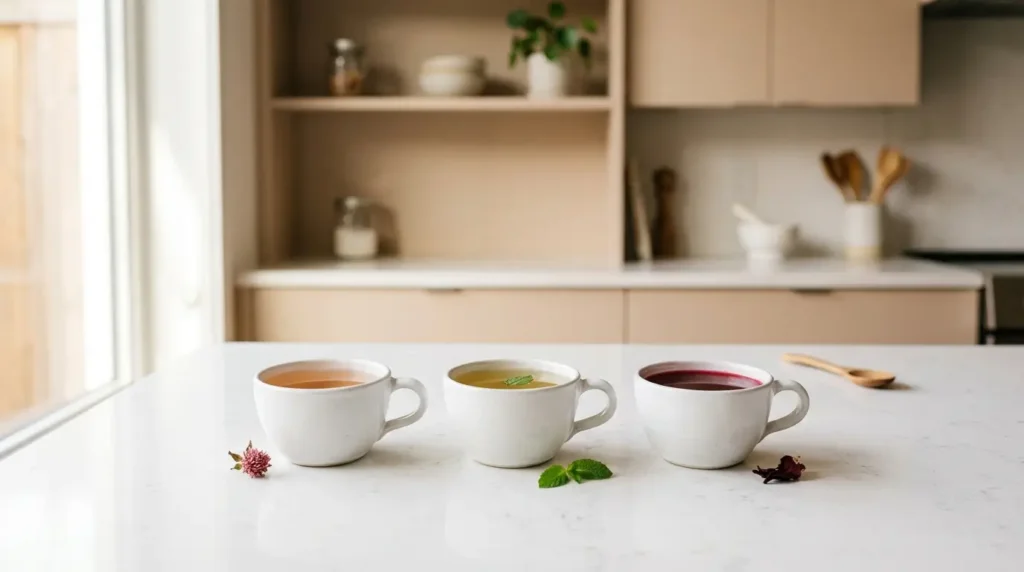
Red clover is one of several caffeine-free herbal teas commonly discussed in relation to women’s health. However, these teas contain different plant compounds and should not be considered interchangeable treatments for hormonal or menopausal conditions.
| Herbal tea | Main compounds or characteristics | What research has explored |
|---|---|---|
| Red clover | Isoflavones | Menopausal symptoms and other hormone-related outcomes, mainly using standardized extracts |
| Spearmint | Polyphenols and aromatic compounds | Hormone-related markers in a limited number of human studies |
| Hibiscus | Anthocyanins and other polyphenols | Blood pressure and cardiometabolic markers in adults |
| Chamomile | Apigenin and other flavonoids | Relaxation and sleep-related outcomes |
| Nettle | Various polyphenols and micronutrients | Several traditional uses, with evidence varying considerably by outcome |
The presence of these compounds does not mean that drinking the teas will treat menopause, hormonal imbalance, PCOS, anxiety or other medical conditions.
It is also important to distinguish research on brewed tea from studies using standardized extracts, supplements or isolated compounds.
For more information, see our guides to hibiscus tea benefits for women, spearmint tea benefits, chamomile tea benefits and nettle tea benefits.
How to Make Red Clover Tea

Can You Combine Red Clover With Other Herbal Teas?
Red clover can be combined with other caffeine-free herbal teas for flavor and variety. For example, some people enjoy blending it with spearmint, chamomile or hibiscus.
However, combining herbal teas should not be considered a treatment for hormonal imbalance or menopause symptoms. Each herb contains different plant compounds, and research on one herb cannot automatically be applied to a blend.
If you want to combine red clover with spearmint tea, choose the blend primarily for taste rather than expecting a specific hormonal effect.
People taking medications, using hormone therapy, or managing a hormone-sensitive medical condition should discuss regular red clover use with an appropriate healthcare professional.
Red Clover Tea Side Effects and Safety
Red clover contains biologically active isoflavones, and its safety profile may differ depending on whether it is consumed as a brewed tea or as a concentrated extract or supplement.
For most health-related uses, research has focused more heavily on standardized extracts than on ordinary red clover tea. This makes it difficult to define a universal amount of tea that is appropriate for everyone.
Hormone-Sensitive Conditions
Because red clover isoflavones can interact with estrogen receptors, people who have a current or previous hormone-sensitive medical condition should discuss regular red clover use with an appropriate healthcare professional.
This is particularly important when considering concentrated extracts or supplements.
Medications and Hormone Therapy
Red clover products may not be appropriate with certain medications. If you take anticoagulant or antiplatelet medication, use hormone therapy, or regularly take prescription medicines, discuss red clover with your healthcare professional before making it a regular part of your routine.
Pregnancy and Breastfeeding
There is not enough reliable human evidence to establish the safety of red clover tea during pregnancy or breastfeeding.
Pregnant or breastfeeding women should therefore discuss its use with an appropriate healthcare professional rather than assuming that an herbal tea is automatically safe.
What About Red Clover Tea for Men?
Red clover’s phytoestrogen content sometimes raises questions about testosterone and male hormones.
However, there is not enough evidence to conclude that ordinary red clover tea meaningfully lowers testosterone in men. Research involving concentrated isoflavones or extracts should not automatically be applied to a cup of brewed tea.
Frequently Asked Questions
What are the benefits of red clover tea?
Red clover contains isoflavones, plant compounds that can interact with estrogen receptors. Research on red clover has explored menopausal symptoms, bone health and cardiovascular markers, but much of this research has used standardized extracts rather than brewed tea. The specific health benefits of drinking red clover tea are therefore less certain.
Is red clover tea good for menopause?
Red clover is frequently studied in relation to menopause because of its isoflavone content. Some studies of standardized red clover extracts have reported improvements in menopausal symptoms such as hot flashes, while others have found limited or inconsistent effects. There is not enough evidence to conclude that ordinary red clover tea provides the same effects.
Does red clover tea have caffeine?
Plain red clover tea is naturally caffeine-free. However, check the ingredient list when buying a tea blend because products containing black tea, green tea or other caffeinated ingredients may contain caffeine.
Does red clover increase estrogen?
Red clover contains phytoestrogens called isoflavones that can interact with estrogen receptors. This does not necessarily mean that drinking red clover tea increases estrogen levels in the body. Evidence is not sufficient to conclude that ordinary red clover tea meaningfully raises circulating estrogen.
Is red clover estrogen?
No. Red clover does not contain human estrogen. It contains plant compounds called isoflavones that are classified as phytoestrogens because they can interact with some estrogen receptors.
What are the side effects of red clover tea?
Research specifically evaluating the side effects of ordinary brewed red clover tea is limited. Red clover contains biologically active isoflavones, and concentrated extracts or supplements may not have the same safety profile as tea. People taking medications, using hormone therapy, or managing hormone-sensitive conditions should discuss regular use with an appropriate healthcare professional.
Is red clover better than soy for phytoestrogens?
Both red clover and soy contain isoflavones, but their specific isoflavone profiles differ. Comparing them simply by saying one contains “more estrogen” can be misleading. The amount consumed, preparation and type of product also matter.
Can men drink red clover tea?
Red clover tea is sometimes consumed by men as an herbal beverage. There is not enough evidence to conclude that ordinary red clover tea meaningfully lowers testosterone or produces feminizing hormonal effects. People with medical conditions or those taking medications should consider their individual circumstances.
How long does red clover take to work?
There is no established amount of time for red clover tea to “work.” Clinical studies of standardized extracts have used different doses and treatment periods, and their results cannot be used to establish an onset time for ordinary brewed tea.
Is red clover tea safe for everyone?
No herbal product should be assumed to be appropriate for everyone. Red clover contains biologically active isoflavones, and individual circumstances such as pregnancy, breastfeeding, medications, hormone therapy and hormone-sensitive conditions can affect whether regular use is appropriate.
Key Takeaways
- Red clover naturally contains isoflavones, plant compounds that can interact with estrogen receptors.
- Most clinical research on menopause and other health outcomes has used standardized red clover extracts rather than ordinary brewed tea.
- Research on menopausal symptoms such as hot flashes has produced mixed results, and the same effects cannot automatically be attributed to red clover tea.
- Evidence is not strong enough to conclude that drinking red clover tea prevents osteoporosis, improves cardiovascular health, increases collagen or treats hair loss.
- Plain red clover tea is naturally caffeine-free, making it an option for people looking for a caffeine-free herbal beverage.
- Red clover does not contain human estrogen, and drinking the tea should not be described as equivalent to hormone therapy.
- Safety depends on individual circumstances. People who are pregnant or breastfeeding, take medications, use hormone therapy or have hormone-sensitive medical conditions should discuss regular use with an appropriate healthcare professional.
- Concentrated red clover extracts and supplements should not be treated as equivalent to a cup of brewed red clover tea.