
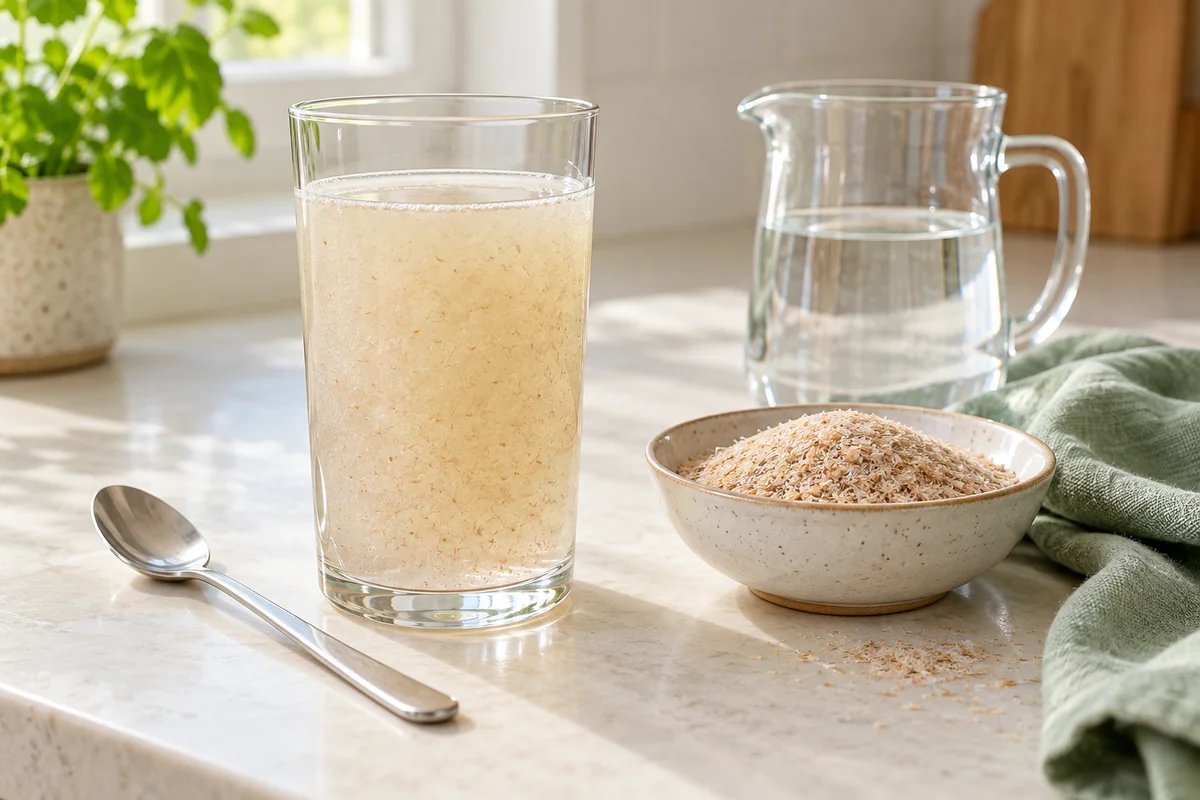
A psyllium husk drink is a measured amount of a psyllium product mixed with the liquid specified on its label and consumed promptly. To take it safely, use your product’s serving instructions, mix thoroughly, and never swallow the dry powder. This is a fiber preparation, not a drink that automatically causes weight loss.
If you searched for “how to take psyllium husk,” the most useful starting point is the container in your kitchen. Whole husks, finely ground powder, and flavored drink mixes can have different serving sizes. A spoonful from one package is not a dependable substitute for a spoonful from another.
This guide explains how to organize the preparation, read the directions, avoid common mixing mistakes, and ask useful questions before starting. It is intended for adults who have already established that their chosen product is appropriate for them. A clinician’s directions take priority over a general drink guide.
What you need before making the drink
Keep the original container, its measuring scoop if supplied, a clear measuring jug, a roomy glass, and a spoon together. You want to finish reading and measuring before the powder touches the liquid. Starting with the water and then searching for a spoon makes the process unnecessarily awkward.
Choose a glass that holds more than the required liquid volume. A glass filled to its rim leaves little space to stir, and a spill can make it difficult to know how much of the prepared serving you consumed. The glass size itself does not tell you how much water you have used; measure the liquid.
A kitchen scale can be useful when the label gives a gram quantity, but it must be accurate at that small weight. If your scale only registers large changes reliably, use the product’s supplied measure instead of pretending that an uncertain reading is precise. Do not convert teaspoons to grams using a number from another brand.
Set aside a few uninterrupted minutes. The drink does not need a decorative garnish, a blender, or a complicated routine. A simple setup makes it easier to notice what the label actually requires and to keep the preparation consistent from one occasion to the next.
Read the label in the right order
First identify the product form: whole husks, plain powder, or a formulated drink mix. Next locate the serving amount, required liquid volume, permitted liquid, and frequency. Check warnings, age restrictions, and storage instructions before considering flavors or variations.
Distinguish “grams of product” from “grams of dietary fiber.” A serving might contain ingredients besides psyllium, so those two numbers do not necessarily match. The front label is often a marketing summary; the detailed panel tells you what the measure means.
Check whether the stated scoop is level or rounded. Avoid adding an extra spoonful because the first glass looks thin. Appearance is not a dose measurement, and a drink that seems watery immediately after stirring may change while it sits.
If the label is missing, damaged, or written in a language you cannot confidently read, ask a pharmacist to interpret it before use. Photographing the complete panel can help you get accurate advice. A product name by itself may not identify the formulation or the instructions for your country.
How to prepare a psyllium husk drink

1. Confirm the amount and liquid instructions
Use the amount your product label or clinician specifies. For many powder and granule preparations, MedlinePlus’s psyllium instructions specify at least 8 ounces, or 240 milliliters, of liquid per dose. They also emphasize following the package or prescription directions. Do not treat this general guidance as permission to ignore a product’s requirements.
2. Measure before you mix
Measure the liquid and the serving separately. For a loose product, return the dry measure to its container before stirring. This keeps the powder dry and reduces the chance of confusing a used utensil with a fresh serving.
3. Follow the product’s mixing sequence
Use the sequence printed on the package, then stir thoroughly. Some products tell you to place granules in a glass and add water; others provide different instructions. Work gently enough to avoid creating a cloud of fine powder. Do not deliberately inhale the powder while inspecting it.
4. Consume promptly as directed
Drink the prepared mixture promptly rather than leaving it to become a thick gel. For example, the NHS instructions for Fybogel call for immediate consumption after mixing. Those directions concern that particular product and should not be copied as a universal serving formula.
5. Clean and reset your setup
Rinse the glass and spoon after use. Close the container, replace the scoop, and leave the directions accessible. A repeatable setup is more useful than making several drinks ahead of time and trying to recover their original texture later.
How much psyllium husk per day?
There is no single spoon quantity that this article can safely assign to every reader. Use the labeled amount for the exact product and purpose, or the amount your clinician recommends. Do not build a daily dose by combining one blog’s powder measure with another website’s whole-husk schedule.
Before adding multiple servings, write down what you are already using. A flavored fiber drink, a capsule, and a plain powder may all contain psyllium. Combining them without noticing that overlap makes the total harder to track.
The number on the nutrition panel is also not a personalized target. It describes the serving in that package. If you need advice about increasing fiber, ask how the supplement fits alongside your food intake, symptoms, and any existing treatment.
Record the product name, labeled serving, and the reason you are considering it. These details make a pharmacy conversation more useful than asking, “How many spoons should everyone take?” A suitable plan should answer your situation, not a social-media challenge.
Whole husks and powder are not interchangeable spoon for spoon
Whole husks and finely ground powder look different, and the same spoon can hold different weights. Product formulations can differ further when flavors or other ingredients are included. Use each container’s own directions when changing brands or forms.
Keep an old scoop out of a new product unless the new package explicitly tells you to use it. A familiar scoop can feel convenient while hiding a measurement mismatch. Label your scoop if you keep several supplements in the same cupboard.
If you are comparing products online, compare the instructions for the exact form you intend to buy. A photograph of a large bag of whole husks does not establish the serving for a small tub of concentrated powder. Similar names do not make the labels identical.
Can you mix psyllium with juice, milk, or a smoothie?
Use only a liquid or food preparation allowed by the product directions. Water keeps the ingredient list simple, but that does not mean every product requires exactly the same water preparation. Do not assume a thick smoothie supplies the same mixing conditions as a measured glass of liquid.
If your label permits juice, check the portion and added ingredients before making it your default. You can browse our juicing recipes with measured portions for separate juice ideas; they are not validated psyllium delivery methods.
Likewise, our whole-fruit smoothie recipes are ordinary drinks with their own ingredients and texture. Adding psyllium changes the preparation. Keep them as separate choices unless your product directions or pharmacist confirm how to combine them.
Avoid inventing a mixture of several supplements just because each sounds useful alone. That makes it harder to check serving instructions and harder to identify which ingredient caused a problem. For your first preparation, choose the simplest label-compliant option.
Flavor ideas without changing the serving
For an unflavored product that permits a suitable liquid, choose the liquid before measuring it and adding the psyllium. Do not mix first and then wander away to find juice or another ingredient. The useful variation is a taste choice that still respects the instructions.
Keep any additions modest and optional. A drink does not become more effective because it contains a long list of “wellness” ingredients. A recipe video’s color, garnish, or claims should not decide the amount of fiber you take.
If you prefer an ordinary flavored beverage instead, our lemon ginger tea recipe is a separate option. It does not perform the same role as a psyllium preparation, and there is no need to combine the two to enjoy either drink.
When should you take it?
Let the product directions and your medication schedule decide the timing. Do not adopt a universal “before breakfast,” “on an empty stomach,” or “right before bed” rule from a recipe headline. A convenient routine still has to fit the particular preparation.
For Fybogel, the NHS advises taking it after food and leaving at least an hour before bedtime for the evening drink. That is product-specific guidance. Ask your pharmacist what applies to your own product rather than moving another brand’s schedule onto your label.
Choose a time when you can measure, mix, and drink without rushing. Preparing it while leaving home or immediately before a long meeting can encourage shortcuts. You should also have time to read a warning or ask a question before you repeat the preparation.
Psyllium and other medicines
Have a pharmacist check your full medication and supplement list. Do not assume every medicine needs the same separation interval. MedlinePlus identifies some medicines requiring a three-hour gap, which is one reason a general “two hours for everything” instruction is inadequate.
Bring the exact fiber product to the discussion, along with your usual dose times. Ask for a schedule you can follow without missing essential medicines. Do not move, stop, or reduce a prescribed medicine to make room for a drink routine.
If your schedule is complicated, request written instructions. A small table showing each product and its time can be easier to use than remembering several verbal rules. Review that table if a medicine or fiber formulation changes.
Troubleshooting the preparation
Clumps: Check that you used the label’s liquid volume and mixing sequence. Make sure the serving was measured correctly. Do not solve a clumpy drink by adding another scoop.
A mixture left standing: Do not force yourself to swallow a thick or uncomfortable preparation. Use the product guidance or ask a pharmacist about what to do. Preparing a fresh serving is preferable to improvising a way to swallow a gel, but avoid accidentally taking an additional dose if you already consumed part of the first.
An unpleasant taste: Review whether the label permits another liquid or whether a different formulation would suit you. Avoid masking the taste with a large amount of sweetener while losing track of the drink’s ingredients.
An uncertain amount: If you cannot tell how much you measured or consumed, do not automatically repeat the whole serving. Ask a pharmacist for advice. This is why measuring first and using one glass helps.
A wet scoop: Wash and dry utensils before returning them to the container. Use clean, dry equipment and follow the storage directions. Keep the original label attached rather than decanting powder into an unmarked kitchen jar.
Side effects and reasons to seek help
The NHS side-effect guidance for Fybogel lists wind and bloating and advises discussing persistent or worrying symptoms with a clinician or pharmacist. It also describes allergic reactions. Trouble breathing, throat swelling, or difficulty swallowing needs urgent medical attention.
The manufacturer’s Fybogel safety information identifies swallowing problems and intestinal obstruction as important contraindications. If you have restrictions on fluid intake, get individual advice before considering a preparation. New or worsening symptoms are not proof that a supplement is “working.” Do not respond by increasing the serving.
For constipation, follow the product’s treatment duration and its instructions about contacting a clinician. MedlinePlus advises against taking psyllium for longer than one week without medical direction. A recipe page cannot decide whether persistent constipation needs a different assessment.
Keep expectations practical
A psyllium drink is not a meal, a detox, or an automatic substitute for varied foods. Decide what problem you are trying to solve before buying a product. That makes it easier to judge whether the preparation is appropriate and whether you need professional guidance.
For a broader explanation of the ingredient and the research, read what psyllium husk is and what its benefits mean. This preparation guide focuses on using a chosen product correctly; the companion article examines the evidence behind its claims.
FAQS
How do you take psyllium husk?
Use the serving and liquid instructions for your exact product, mix thoroughly, and consume promptly as directed. Never swallow the dry powder. Ask a pharmacist if the label is unclear or you take medicines.
How much psyllium husk should you take per day?
Follow the product label or your clinician’s directions. Whole husks, powder, and formulated drink mixes can have different serving measures. There is no universal tablespoon dose for everyone.
Can you prepare a psyllium drink the night before?
Prepare it immediately before use and follow the label. It thickens on standing, so an overnight preparation is unsuitable for the prompt-consumption method described here.
Can you use juice instead of water?
Only if the product directions allow that liquid. Use the specified volume and check the juice portion and ingredients. Do not replace the required liquid with a small splash.
Is psyllium powder the same as whole husks?
They are different forms of psyllium. Their volume measures and instructions may differ, so do not exchange them spoon for spoon or reuse a scoop without checking.
Should you take psyllium with your medicines?
Ask a pharmacist about the exact product and each medicine. Separation requirements can differ. Do not assume one timing rule applies to every medication or change prescribed doses yourself.